Off We Went To The White Continent…


SONY DSC

JET and I have always had a sense of wanderlust, a deep desire to travel to the four corners of our earth.  A couple years ago, we finally bit the bullet and reserved a cabin on an expedition cruise to Antarctica, the White Continent.  Antarctica has been on our travel bucket list for decades, for good reasons:  1) Antarctica is not easy to get to.  It involves two days at a minimum to reach the port city of Ushuaia, at the very bottom of Argentina,
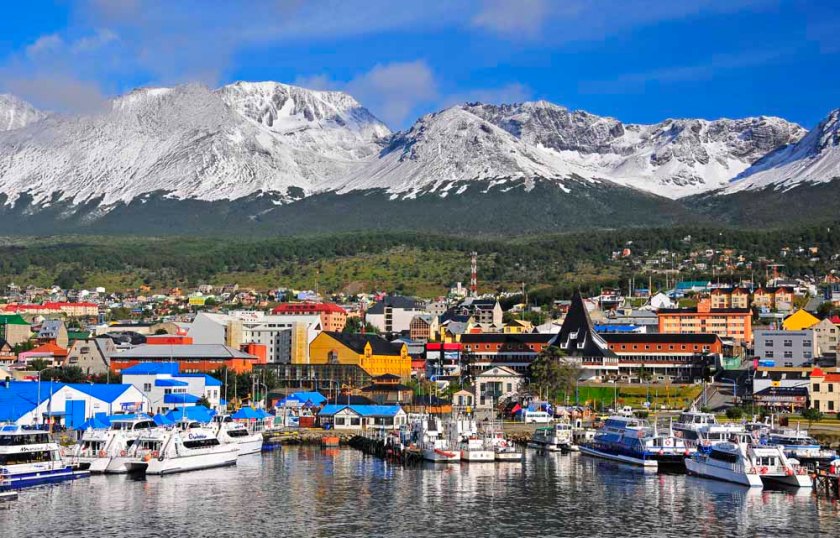
ushuaia

then another two days crossing the Drake Passage, arguably the roughest body of water in the world.

Plancius proposed sailing route

2)  the window of opportunity for a visit is short, from Mid November through March.  3)  Accordingly, it is quite expensive, due to 1 and 2 above.

Most tour operators open up itineraries as far out as two years from the embarkation date, primarily to allow enough time for normal folks to save up coin and pay for the trip over time.  There is no turning back now…the trip is fully paid for, our bags are packed with assorted clothing that is quite foreign to most Floridians…
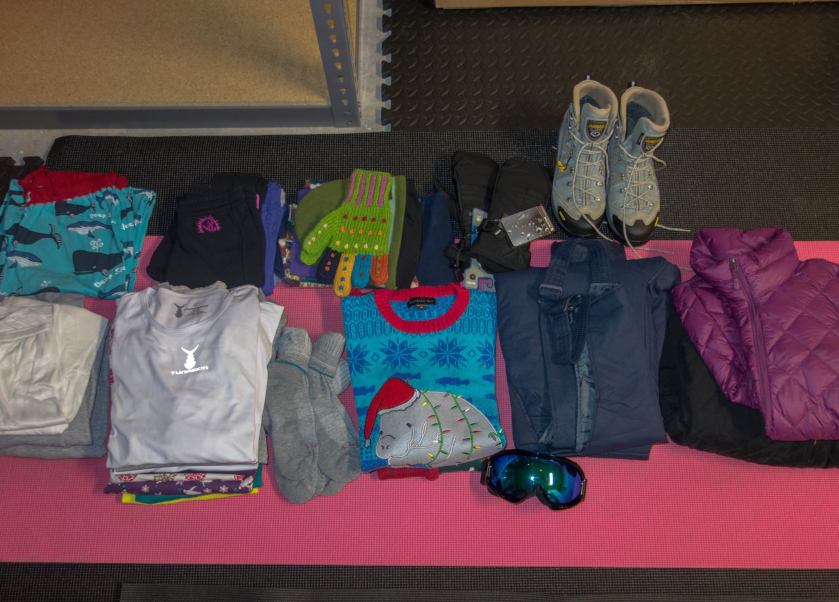
warm clothes

…and we head for the airport in a matter of days…

Rumor has it that we will have internet access during the cruise.  I plan to keep a daily journal of our journey, and post updates each day, if possible….next up…..Buenos Aires, Argentina…hasta pronto!!!
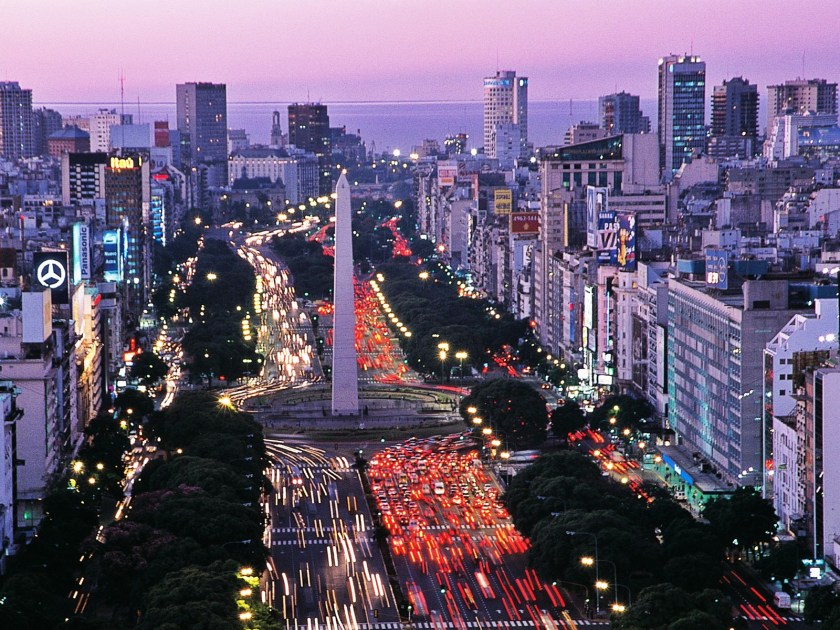
Buenos-Aires

Interesting Facts about Antarctica

  1.  About 37,000 people visit Antarctica each year, which is approximately .0005% of the world’s current population.  About 5,000 people live on Antarctica during the summer, and only 500 year round.
  2. The largest land animal in Antarctica is an insect, a wingless midge, Belgica antarctica, less than 13mm (0.5in) long. There are no flying insects (they’d just get blown away), just shiny black springtails that hop like fleas and often live among penguin colonies.
  3. If Antarctica’s ice sheets melted, the worlds oceans would rise by 60 to 65 meters (200 – 210ft) – everywhere.
  4. Antarctica is the best place in the world to find meteorites. Dark meteorites show up against the white expanse of ice and snow and don’t get covered by vegetation. In some places, the way the ice flows concentrates meteorites there. The ice makes them gather in one place.
  5. It has been estimated that during the feeding season in Antarctica, a full grown blue whale eats about 4 million krill per day (krill are small shrimp-like creatures), that’s 3600 kg or 4 tons – every day for 6 months. Having laid down a layer of fat from this feeding activity in Antarctica, they then starve for several months.This daily intake would feed a human for about 4 years! If you could stomach it. Krill may be nutritious but they’re not very nice as people food – which is lucky for the whales!
  6. Antarctica is the only continent with no native species of ants, and no reptiles.
  7. The coldest temperature ever recorded on Earth was minus 128.56 degrees Fahrenheit (minus 89.2 degrees Celsius), registered on July 21, 1983, at Antarctica’s Vostok station.
  8. The average thickness of Antarctic ice is about 1 mile (1.6 kilometers).
  9. In January 1979, Emile Marco Palma became the first child born on the southernmost continent. Argentina sent Palma’s pregnant mother to Antarctica in an effort to claim a portion of the continent.
  10. The male Emperor penguin is the only warm-blooded animal that remains on the Antarctic continent through the winter. It stays to nest on the single egg laid by its mate (the female spends nine weeks at sea and returns in time for the egg to hatch).
  11. The Antarctic Peninsula, which juts out into warmer waters north of Antarctica, has warmed 2.5 degrees Celsius (4.5 degrees Fahrenheit) since 1950, according to the U.S. National Snow and Ice Data Center. That’s about five times the rate of warming measured for the rest of the world, according to NASA.
  12. Antarctica is the largest desert in the world.
  13. 90% of the world’s ice and 70% of the world’s fresh water is in Antarctica.
  14. No sitting U.S. president has visited Antarctica.
  15. Every year, a half marathon, marathon and a 100K run take place in Antarctica despite an average wind chill of -20°C, or -4F.
  16. There are more than 40 airports in Antarctica.
  17. You cannot work in Antarctica unless your wisdom teeth and appendix are removed.
  18. Antarctica (technically) contains every time zone on the planet.

12/14 & 12/15/2017 Away We Go!!!

We dropped Ellie at Cyndi’s home in Plantation for her first sleepover away from home in 11 years.

We continued on to MIA, and arrived at the Aerolineas Argentinas check-in counters four hours before our departure time.  One important note regarding travel to Latin America:  Better not be in a hurry, because they are not in any hurry at all.  We stood in a quite lengthy line for over 30 minutes before they even opened up the counter stations, and it took us 90 minutes total to check in and clear security.  We struck out at both the Delta Sky Club and the Priority Pass Lounge.  The one drawback to getting free “memberships” via certain credit cards is that the clubs can refuse entry for basically any reason.  We have been fortunate up to this point….c’est la vie…

Our very full flight included two of the narrowest, cramped seats we have encountered in 35 years of travel.  I could barely fit into the narrow seat, and it was physically impossible to have my knees within my seat boundary.  I kept my left leg in the aisle the entire flight, moving only when the carts came through.  Accordingly,  I basically did not sleep at all, because I had to get up every 90 minutes or so to “un-sleep” my leg joints.  JET and I plan to make every reasonable effort to fly business class going forward on any flights over 6 hours in length.

We landed on time in Buenos Aires.  90 minutes later, we met the car and driver waiting for us and arrived at the Palacio Duhau Park Hyatt by 7:00 AM.  The travel gods took some pity on us, and we were able to check into our room right away…I highly recommend this hotel.  Splendid rooms, excellent service and location, good food.  The rack rates are pricey, but if you belong to the Hyatt Rewards program, you can get a $700 room for free with 20,000 points or $125 and 10,000 points.  We had enough time before our tour of the city at 9AM to change clothes, freshen up and have a nice breakfast overlooking the hotel gardens…

We booked a 7 hour full day city tour with toursbylocals.com.  It was $460 for a private tour with a knowledgeable, English speaking guide with car.  The only exclusions were our lunch and bottled water.  Andres met us promptly at 9AM…over the next 7 hours we visited the following Buenos Aires attractions:

Plaza de Mayo, site of many current demonstrations, Pope Francis’ former Buenos Aires Cathedral and the Government House where Eva Peron made many speeches.

La Boca/Caminito – the old port area where the “Tango” dance was born, also home to colorful homes with walls made from corrugated metal, and many beautiful murals.

San Telmo – a neighborhood famous for its many antique stores, and markets.  We had a superb lunch of home made empanadas followed by Alfajores de Chocolat dessert cookies.

The widest Avenue in the world, 9 de Julio, 16 lanes across, the Obelisco and the Buenos Aires Opera House.

Recoleta Cemetery walking tour, including Eva Peron’s mausoleum and the mausoleum of Rufina Cambaceres, the “woman who died twice”.

Palermo neighborhood, filled with embassies and old money mansions.

Rio De La Plata Estuary river park.

We returned to our hotel at 345PM, thoroughly exhausted after 24 hours of travel and touring.  After cleaning up and looking through our pictures, we decided to order room service for dinner.  40 hours without sleep will do that to you…..on to Ushuaia in the morning…buenas noches!!!
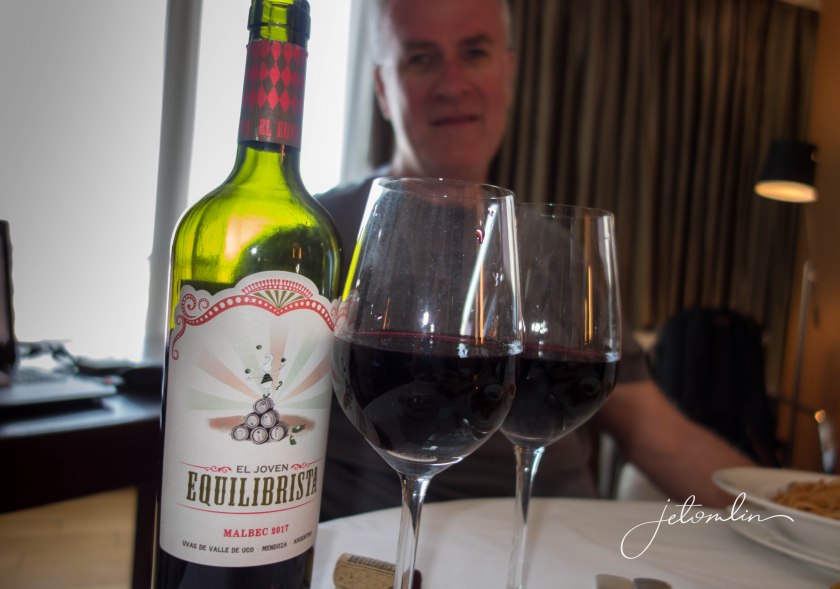
 

DSC05112


12/16/2017  – Ushuaia, Argentina (The End of the World)

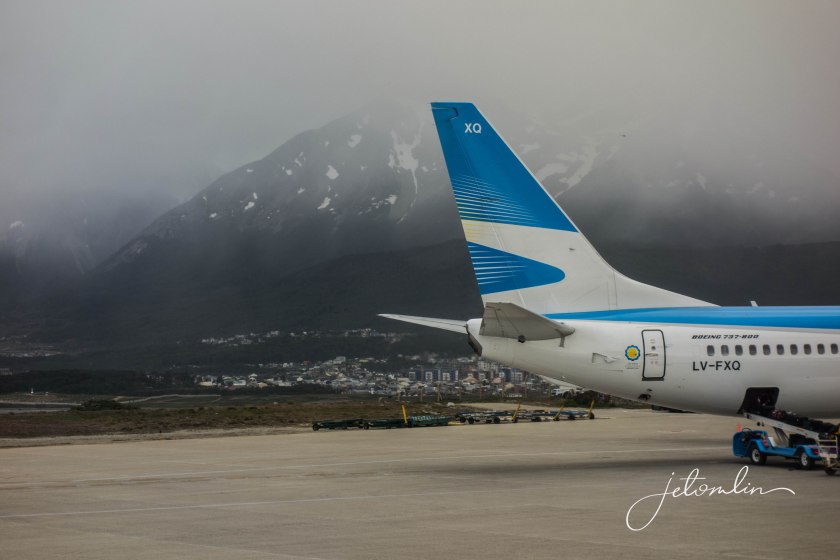
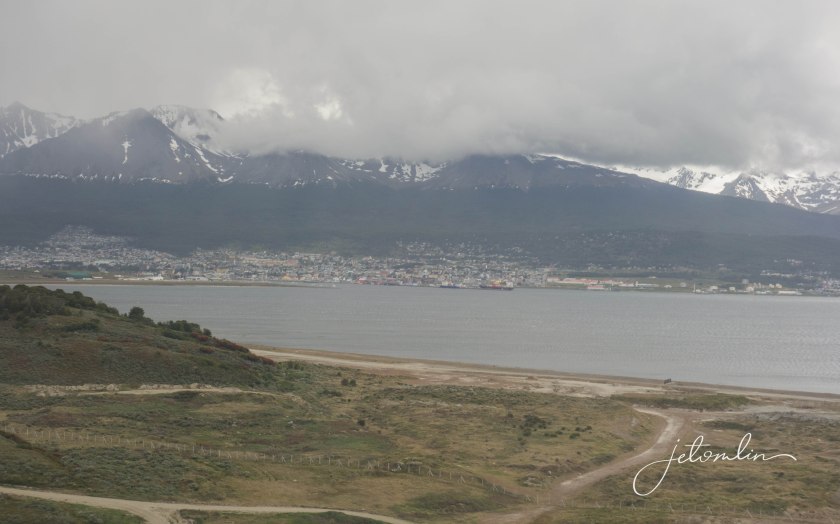
We left the comfort of our heavenly Buenos Aires hotel after a hearty breakfast and headed to Aeroparque Jorge Newberry for a mid morning flight to Ushuaia, some 1,600 miles south of Buenos Aires.
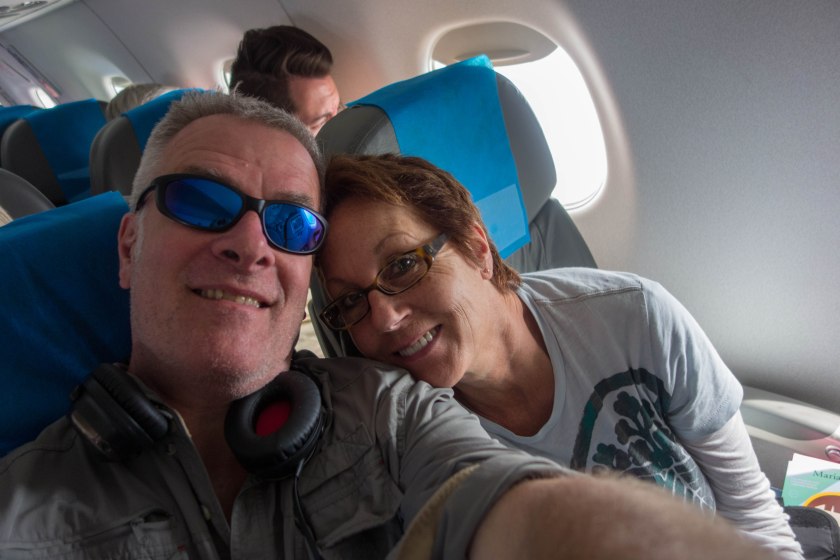
DSC05119.jpg

DSC05135.jpg

DSC05141.jpg

Ushuaia is the southernmost city in Argentina, and a jumping off point for Antarctica expeditions.  The brisk wind and very cool temps hit us quickly,  a harbinger of the weather ahead for the next two weeks.

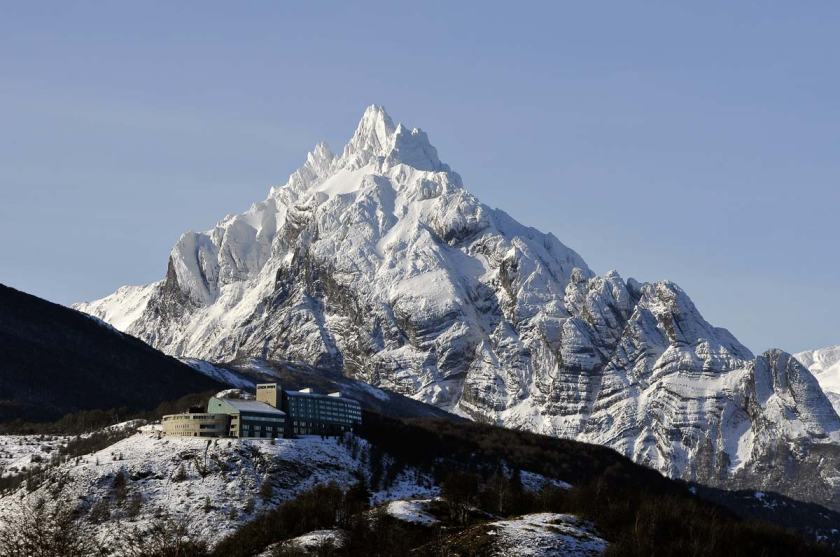
We took a taxi up,up,up to our home for the next two nights, the Arakur Resort & Spa, a newish, beautifully designed property about 20 minutes and 1,000 feet up the mountain from town.  This place is not cheap, but for the view, facilities and comfort, it is quite the place to relax for a couple nights pre-cruise.  We were fortunate enough to secure two nights on the front end and one night after the cruise by cashing in some credit card points.  The room for the night at the end of the trip does not have the channel view shown below, but sometimes one must just suck it up…
Arakur-ushuaia-resort-spa-1

The property sits on a reserve of a couple hundred acres with hiking trails in the foothills.  Included in the room rate are several free daily hikes led by guides…we signed up for the late afternoon one…there is also a full spa, pool and fitness center, and a free hourly shuttle to/from town….

JET and I have been blessed with some incredible journeys over the last 35 years….this one is shaping up to be at the top of the list, and we are barely into it…

A Room with a View
room 210 view of Ushuaia

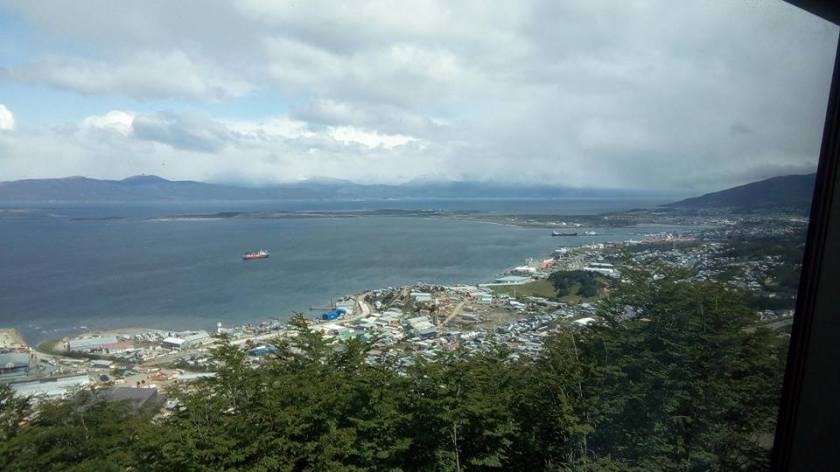
The view of Ushuaia from room 210…very high tech room…the curtains are motorized and can be set to open and close at certain times of the day…
room 210

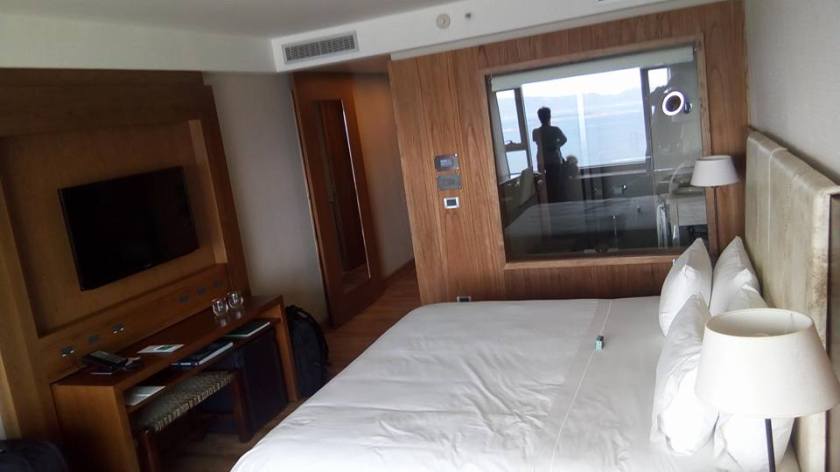
There is a king sized bed, plenty of seating and many outlets…
room 210 3

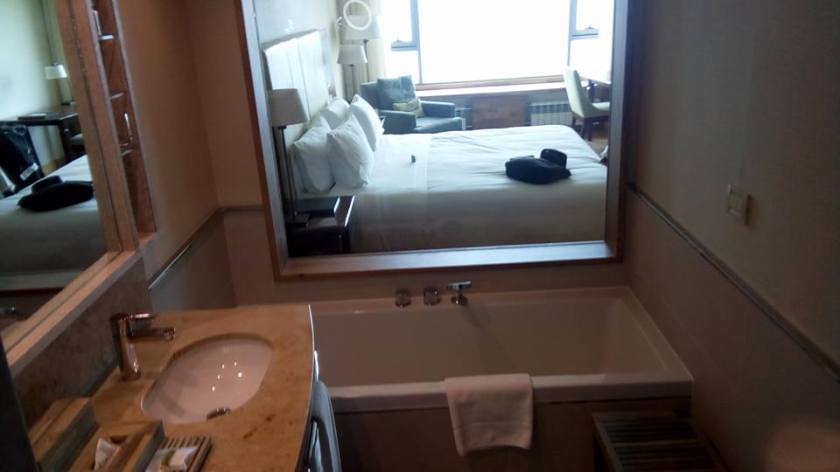
The bathroom has a separate rain shower, dual vanity sink and a huge soaking tob with that view…
DSC04540.jpg

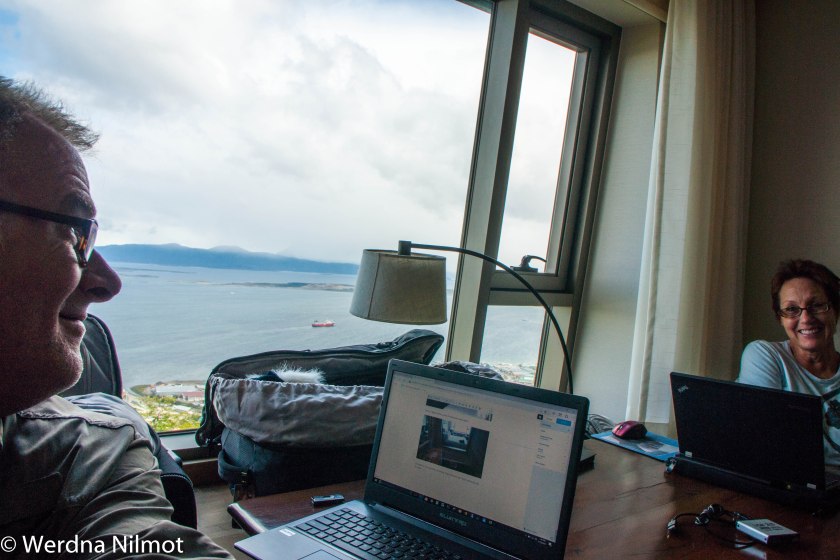
We moved the desk in front of the picture window so we could both work at our laptops…

More to follow after our hike…

Afternoon Hike with Daniella from the Arakur Resort

We went on a 2 hour hike through the preserve surrounding the hotel with another couple and Daniella, one of the hotel guides.   The fresh,cold mountain air is intoxicating.  We saw peat bogs, lichens that will only grow in areas that has essentially pollution free air, trees that fell over and fused with other trees instead of dying, a very out of place cow skull and beautiful birds that followed us on our trek….what a wonderful way to spend an afternoon….please enjoy some photos from our hike…

12/17/2017  A Day of Rest and Reflection, with an eye toward Embarkation Day…

The Arakur Hotel was a great choice to unwind after 48 hours of long travel.  Everything about this place is about minimizing stress, claustrophobia and rushed feelings.  The public spaces are enormous, with 12 foot floor to ceiling windows looking out over the Beagle Channel below…

Looking toward the mammoth sitting areas from the front desk.  There are dozens of very comfortable chairs and sofas in three separate areas…the farthest room in the distance is where the bar is, which also is a splendid place for lunch…
DSC05169

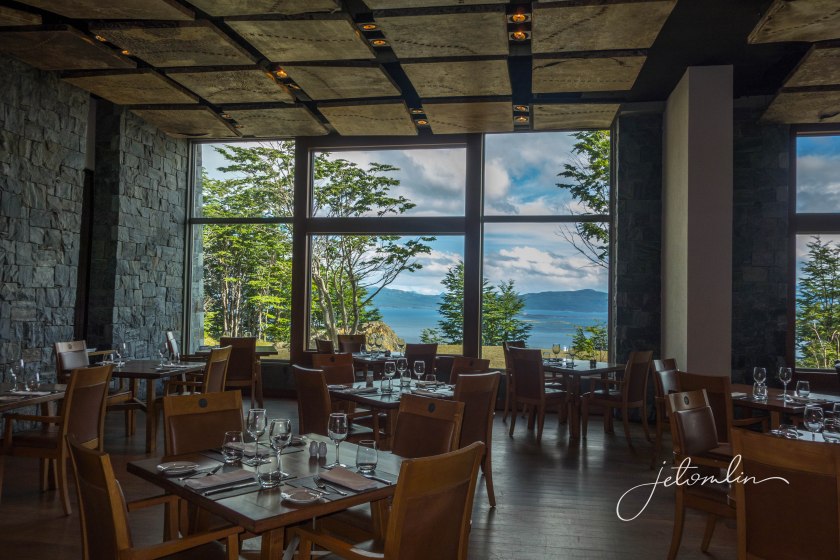
The restaurant is equally spacious, probably capacity for 200 diners, and the tables are spaced well apart from one another….a lot of thought was placed on these areas, and how to create a tranquil environment…

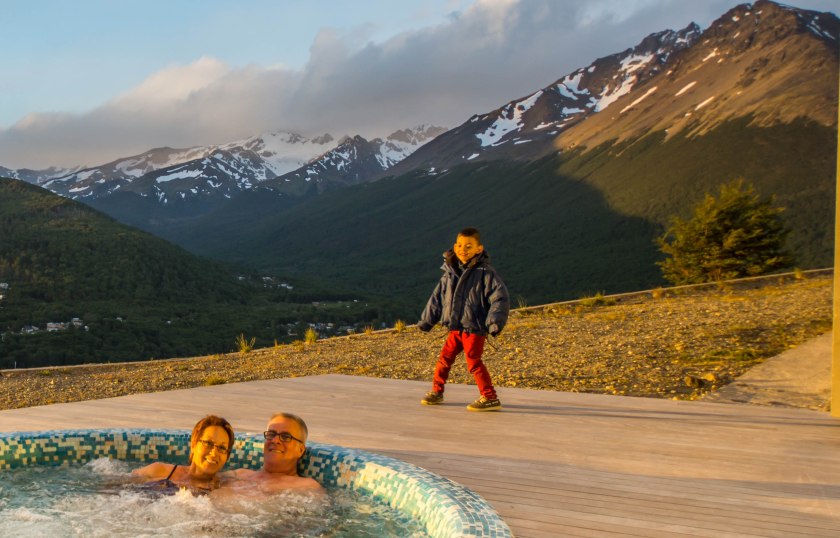
Guests can explore the hotel grounds in relative solitude…the fresh mountain air is intoxicating…or perhaps spend an hour or six in the pool and spa,complete with swim under outdoor infinity pool and hot tub, with majestic mountains as your backdrop…
_DSC2077

***

After breakfast, we took a shorter hike up to the summit above the hotel, since the skies were relatively clear and the sun was out…

We then decided to take the complimentary shuttle down the mountain to town and explore a bit.  Unbeknownst to us, not much is open at all on Domingo.  We still enjoyed walking around this quirky little port town…

After walking around for a couple of hours, we decided to stop at a small panaderia for some café negro…..on a whim, we decided to partake of the national beverage, “mate” (pronounced mah-tay)…  from Wikipedia:  “Mate is traditionally drunk in a particular social setting, such as family gatherings or with friends. The same gourd (cuia) and straw (bomba/bombilla) are used by everyone drinking. One person (known in Portuguese as the preparador, cevador, or patrão, and in Spanish as the cebador) assumes the task of server. Typically, the cebador fills the gourd and drinks the mate completely to ensure that it is free of particulate matter and of good quality. In some places, passing the first brew of mate to another drinker is considered bad manners, as it may be too cold or too strong; for this reason, the first brew is often called mate del zonzo (mate of the fool). ”

I second the notion that the first brew is often called “mate of the fool”, because I felt pretty foolish after a few swigs of this beverage…perhaps it is an acquired taste…

We quickly asked the waiter for dos café negro, por favor…

Next up:  Embarkation Day!!!
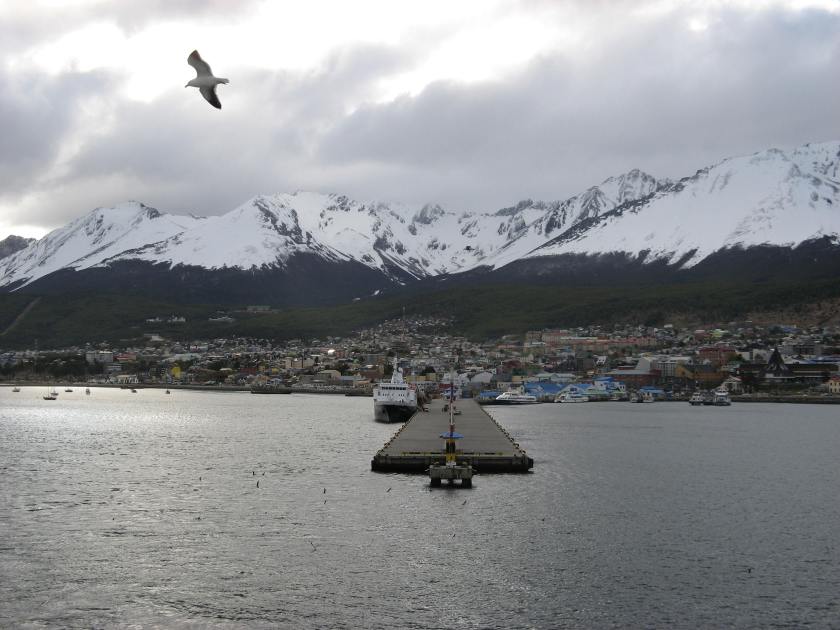
ushuaia cruise ship dock

12/18/2017 – Embarkation aboard m/v Plancius

SONY DSC

The photo above was taken from the bridge observation deck aboard m/v Plancius, our home for the next 11 nights.  Plancius is an ice rated former research vessel that now accommodates around 100 passengers during both Arctic and Antarctic voyages.  Although not at all swanky, Plancius offers comfortable cabins, roomy common areas, 24 hour coffee, tea, hot chocolate and snacks.  The bar in the lounge is reasonably priced.  Meals are served in a somewhat cramped dining room.  Breakfast is always buffet style, lunch and dinner are served both plated and buffet equally.  The food is plentiful, if on the bland side.  Vegetarians will struggle to find much variety over an almost 2 week voyage.  Vegans?  Hahahahahahahahahahaha…fugeddaboudit…

Top and bottom left:  our cabin;  Bottom center:  dining room;  Bottom right: obervation lounge

We arrived at the pier late afternoon, and breezed through “security”…..because there was no security.  No one checked our passports or ship boarding documents, either at the main entrance or at the ship gangway.  I know it is the small port of Ushuaia versus the Miami cruise port, but it was odd that they let us on without confirming our identity at the very least…

Plancius set sail shortly after 6 PM local time.  By this time, most passengers had unpacked and stowed their luggage, and had congregated in the observation lounge to mingle.  First up was a mandatory lifeboat drill complete with survival life vests and a tour of the two lifeboats, each capable of carrying 63 passengers.
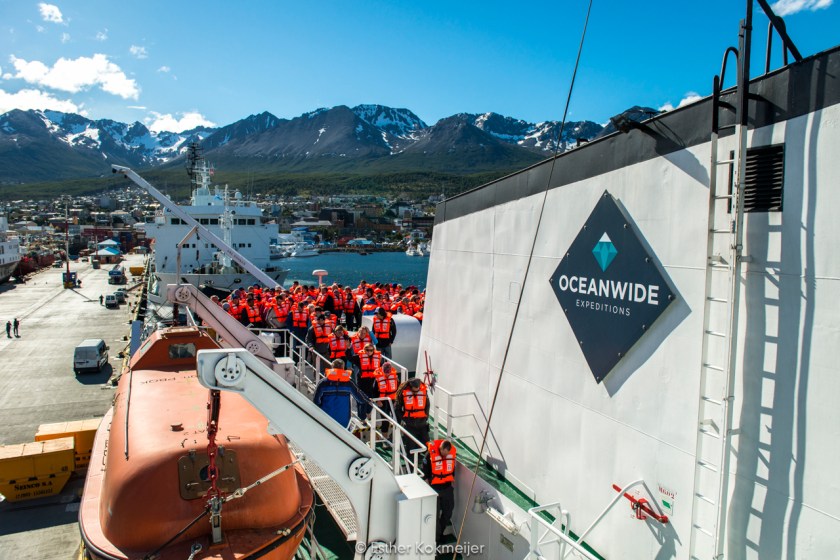
2017-12-18 - Leaving Ushuaia Esther Kokmeijer-12.jpg

Next, we celebrated embarkation with the ship and expedition teams in the lounge over a champagne toast.  Dinner was served afterward.

One of the odd things about summer at the end of the world is that it stays light very late, and never really gets pitch dark.  After dinner, most guests were either in the lounge or out on deck, watching the Beagle Channel drift by – Argentina to the north, Chile to the south.  We spent time chatting with other guests and enjoying the anticipation of the journey ahead.  One interesting thing about a trip to Antarctica is that most of the passengers are very well traveled.  it was not uncommon to meet people who had traveled to over 100 countries, and about half of the ship’s passengers were visiting their seventh and final continent on this voyage.  No less than 3 other ships departed around the same time as Plancius.  Here are some images from the first evening at sea…

12/19 & 12/20/2017 – The Drake Passage

A cup of tea during the outbound Drake crossing…

The Drake Passage is arguably the roughest body of water in the world.  The Atlantic, Pacific and Southern Oceans converge, with little land to impair their currents.  As a result, 50 foot seas are not at all uncommon.  Hence, the affectionate nicknames for the Drake Passage, the “Drake Shake” and the “Drake Lake”.  Which of these one experiences during a voyage to Antarctica comes down to luck.  We were fortunate going both ways.  The outbound journey was sportier, perhaps a 3 or 4 on a 10 point scale, with a 10 being 50 foot waves.  The return sail was much more calm, perhaps a 1 or 2, and we made great time…

During the roughest parts, the Captain of Plancius closed access to the outside decks, except for the bridge deck.  There are barf bags located all over the ship, and the crew tied these nifty 2 inch thick rope rails in 3 sections of the lounge.  There were times where one could not walk 5 feet without grabbing onto something.  Sitting in a chair in the dining room meant sliding into your neighbor.  A cabin bed became a vibrating massage table.  Here are a couple of videos about 24 and 48 hours into the voyage, the latter of which is just as we can see the outer islands of Antarctica…

JET’s optimistic view

Sporty seas coming into sight of land…

12/21/2017 – Land Ho!!!  Bramsfield Strait to the Neumayer Channel

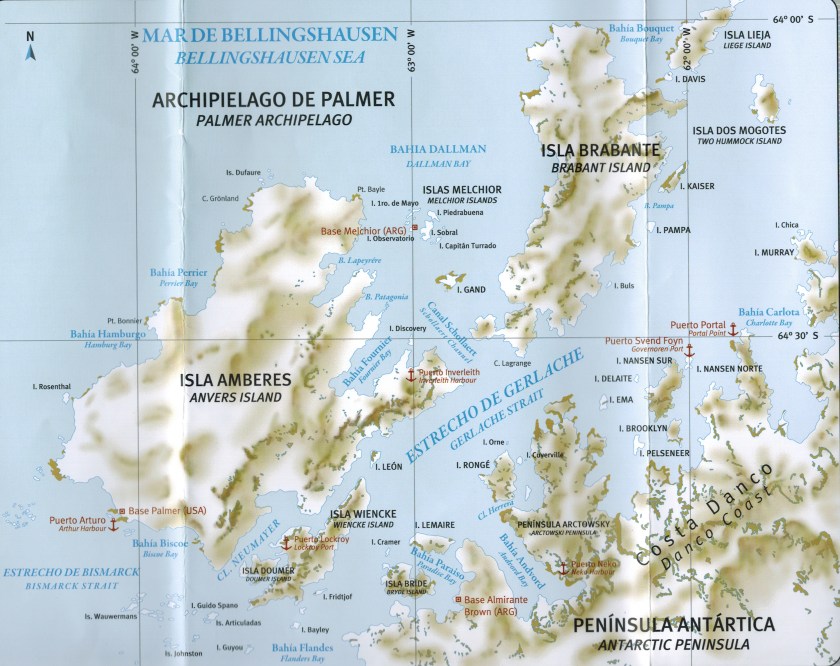
We woke up to the sight of land for the first time in over 2 days….vast mountains and glaciers, not a speck of green to be found, nor any hint of civilization.  The tone among the passengers was electric as we ate breakfast.  This would be our first zodiac excursion to land…technically one of the outer islands and not the Antarctic peninsula itself, but exciting, nonetheless…here is a map of the actual route of our voyage, the area we would spend the next week in, and some photos of our fist glimpse of the white continent…

IMG_20171228_072441[1]

Antarctica Map.jpg

Our first zodiac landing was at Damoy Point.  Zodiac landings in Antarctica are somewhat laborious.  First, you have to put on several layers of warm clothing.  Next comes a water and windproof outer layer, as well as waterproof boots, gloves, hat, perhaps goggles.  Then, we each had to put on the mandatory zodiac life vest, which had to be completely fastened.  Finally, if you were bringing a backpack, it had to be worn so that BOTH HANDS are free.  No slinging it casually over your shoulder.

Once ashore, there were some historical huts to look at, as well as many Gentoo penguin colonies and the penguin highway where Gentoo’s were making their way back and forth to the water. Expedition team members mark the path we are allowed to hike on, and wildlife always has the right of way. We walked past several Gentoo colonies and up to a point called Tombstone Hill where we got a great view of the bay. Ester, one of the Expedition team,  took the photographers to see the penguins and helped her group to take some beautiful pictures. The mountaineering group climbed a ridge directly across the bay from us.  The kayakers were blown out for day one because of strong winds.  After a couple of hours, it was time to return to Plancius for lunch….

After lunch, our second landing of the day was a split landing between Port Lockroy on Goudier Island and Jougla Point. At Port Lockroy, we were able to visit the famous Penguin Post Office and send postcards back to friends and family.  After the post office, we were able to watch Gentoo penguins nesting and some lucky ones were able to see their first Gentoo chicks only a few days old. At Jougla Point we hiked up the ridge to incredible views and more colonies of nesting Gentoo penguins.  After several hours, we returned to the ship for hot chocolate and conversation before the day’s recap and dinner…

12/22/2017 – Cuverville Island and Danco Island

Plancius traversed the Errera Channel overnight, and we were already positioned opposite Cuverville Island by morning, which was to be the location of our first landing, and regarded as having one of the largest rookeries of Gentoo penguins in all of Antarctica.

Conditions in the bay were smooth and the landing was easy. We spent the morning exploring the shore of the island between the various penguin colonies.  The penguins at Cuverville were in the beginning stages of nesting, most still sitting on eggs and putting the final touches to their pebble nests. Numerous brown skuas were circling looking for an easy lunch of an unguarded egg.

After a few hours, we headed back to Plancius for a buffet lunch, but no sooner had we finished was it time to get ready for the afternoons landing at Danco Island.  Snowshoes had been brought ashore, and made the walk a bit easier through the soft snow.  Expedition team leaders led the hike around the island and up to the summit,  and there were even more Gentoo penguins right at the top. The views from the plateau were stunning.

Once the group was gathered back at the shore, it was time for the infamous ‘Polar Plunge’ so those mad enough to brave the icy water got themselves changed. About forty brave souls stripped off and took the plunge.  After the plunge, the group headed back on board Plancius.  Soon, it was time for our daily recap, followed by another dinner filled with conversation about the day…
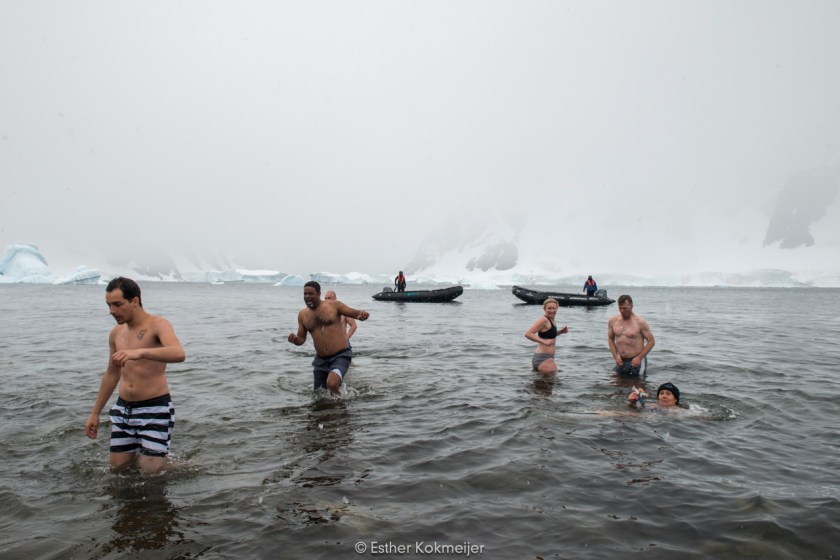
39498117711_482729db59_o

12/23/2017 – Lemaire Channel, Pléneau Island and Port Charcot

The day started very special with a cruise through the Lemaire Channel. Lemaire is known as the most scenic channel in the Antarctic Peninsula. It’s also known as the Kodak Gap, because of the many photos that are taken here. Although often inaccessible due to ice early in the summer our Captain navigated the channel relatively easily, and we were able to enjoy the fabulous views that the narrow channel has to offer.

Plancius anchored off Booth Island, allowing for an ice cruise with the zodiacs. This whole area is known as Iceberg Alley or an iceberg graveyard due the shallow nature of the area, and the huge icebergs that get stranded here during the season.  It is often difficult to get the ship very far into the bay area. The light was perfect, with icebergs were sticking out in front of the dark sky. Unfortunately, the wind speed increased during the first cruise, making the zodiac rides very bumpy, and most everyone got wet. It certainly made for a challenging photography session.

In the afternoon we made a landing on Pleneau Island which is around 1.2 km long. From the cobbled beach on the eastern coast, smooth rock terraces slope gently upwards towards a large crevassed ice‐cap, which covers the western two‐thirds of the island. At the landing site a colony of Gentoo penguins welcomed us. The walk over the ice cap lead us towards the northern end of the island where Blue‐eyed shags were nesting. Half way along the walk was a small colony of Gentoo penguins and there apparently was one Adélie penguin hanging out with the Gentoos.

12/24/2017 – Base Brown & Stony Point

Flanked by icebergs to both sides, Plancius inched her way through the Ferguson Channel.  Crabeater seals were lounging on some ice floes.

We finally reached Paradise Harbor to find that it truly lives up to its name. It was totally calm, and the glaciers and ice peaks were mirrored in the flat water. At Base Brown we went ashore, stepping for the first time on the Antarctic continent.  Here lies the remains of the base that was set aflame by the station doctor in 1984 because he didn’t want to spend another winter there. Base Brown was unoccupied for many years, and now it only operates in the summer.  Argentinians were due to arrive in a week.

After some time ashore we went Zodiac cruising. Some humpback whales were spotted and some Zodiacs even got close to them. On this cruise we saw many blue eyed shags (cormorants) nested high in the cliffs above us,  and many glaciers.

Toward the end of the landing, there was the opportunity for another Polar Plunge. Quite a few passengers took advantage, some for the second time during the voyage.
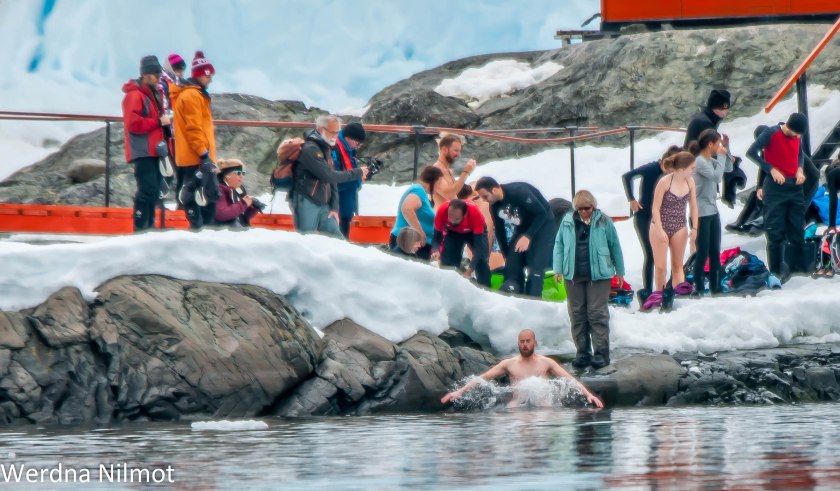
SONY DSC

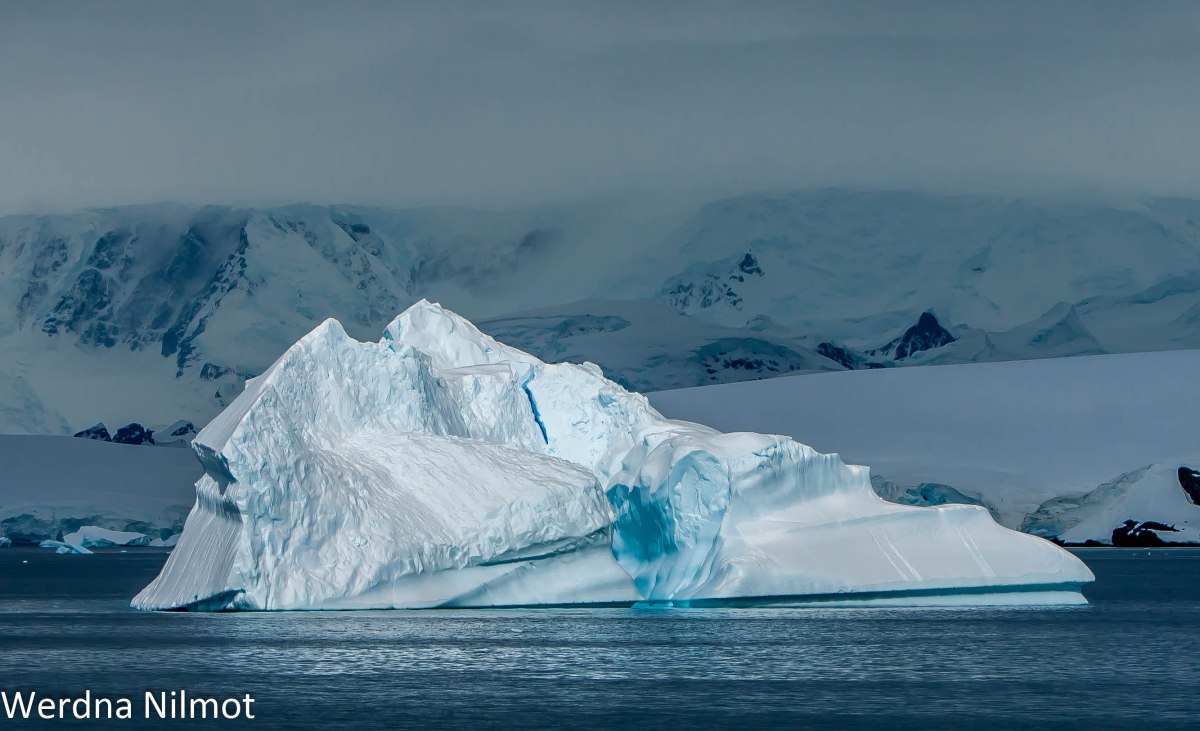
Over lunch the ship relocated to Stony Point, snow covered and dome shaped. From the landing site everybody could pick up a pair of snowshoes and climb to the top. The views were stunning. All around glaciated peaks loomed and the bay was littered with icebergs. It was again calm and the sea was so still that icebergs and cliffs were mirrored in the water. High above us on the slopes the mountaineers worked their way up over some ice fields. From the distance they looked small like ants. At the end of the landing everybody had the chance to make a Zodiac cruise on the way back to the ship and we admired more icebergs in wonderful blue colours and twisted shapes. On the far side of the bay was a small Gentoo penguin colony that we visited. A Weddell seal was hauled out on the snow. He was sleeping and his breath hung like an icy cloud over his snout. A bit further on an ice floe two Crabeater seals dozed in the sun; their fur gleamed golden in the sunlight.

Back on the ship we had an early dinner. Dessert and cheese was this time served in the bar. As a change from normal routine the recap was supposed to be held after dinner, but the appearance of three or more Humpback whales changed all plans. We watched the whales from the windows of the lounge. The show was really good and each time when a fluke was shown applause and loud cheers rose in the lounge rounding up a fantastic day in Antarctica.

12/25/2017 – Orne Islands and Foyn Harbour

Christmas Day in Antarctica…what a surreal feeling to wake up here… after a wakeup call over the PA, those who went outside witnessed spectacular views of the Gerlache Strait, Errera Chanel and Cuverville Island. After a festive Christmas breakfast,  we bundled up in our warm clothing and got ready to get into the zodiacs for a short drive to the Orne Islands. These low-lying islands are found at the entrance to the Errera Channel.  The largest of the islands rise to around 75 metres. Once ashore we got our first glimpse of Chinstrap penguins which were interspersed with other groups of Gentoo penguins.  The snow was hard, so no need for snowshoes. As we climbed we were able to see some small colonies of Chinstraps, Kelp gulls, Skuas and a couple of Crabeater seals lying on the rocks.  There were a few humpback whales feeding in the bay. While we were exploring the islands,  After a couple of hours ashore it was time to get back in our zodiacs and have a delicious Christmas lunch on board.

During lunch, the ship steamed to Enterprise Island at the North of Wilhelmina Bay.  Conditions were sporty, so instead of zodiac cruises/landings, the Captain decided to do a ship cruise of Wilhelmina Bay.  We were entertained by three humpback whales who put on quite a show for us – waving their pectoral fins and displaying their tails as they dived. The whales stayed close to the ship for over an hour and many of us were able to get lovely close up photographs of them as they were swimming. There were also some splendid icebergs in the afternoon sun, which went unnoticed by many watching the whales.

After Christmas dinner, Santa and his penguin helper arrived to the sound of the staff singing ‘Feliz Navidad’ and the passengers were presented with stockings and presents. The day ended with drinks in the bar. All around it was a fantastic Christmas in Antarctica!

12/26/2017 – Deception Island, Half Moon Island and Barrientos Island

Deception Island is named because it conceals an inner harbour within a flooded volcanic caldera. The Captain guided the Plancius though the narrow entrance known as Neptune’s Bellows, avoiding Raven Rock, which waits just below the surface to founder another ship in the middle of the passage. Once safely inside we made our way into Whalers Bay, the site of a former whaling station from the early part of the twentieth century, as well as a British Antarctic research station. From the ship we could see the Norwegian whaling station which operated on shore from 1911 to 1931.  The sheer scale of the oil tanks added to the eerie atmosphere of the old whaling station, a sobering reminder of a destructive era of exploitation.

For those that made the effort to drag themselves out of bed they were certainly rewarded with spectacular views of this volcanic island, bathed in beautiful morning light. We could even see and smell the steam rising from the dark black beach.

From Deception Island, we continued north up to Half Moon Island for our morning landing. Half Moon Island lies north of Burgas Peninsula in the South Shetland Islands and is home to the Argentine Cámara Base.  We were greated with glorious sun and blue skies, and mild temperatures.  The island was a hive of activity in terms of wildlife.  It was difficult to know where to turn your attention.  Half Moon is the home to about 2,000 pairs of chinstrap penguins, many of which were already caring for very small chicks,

The island is also identified as an Important Bird Area (IBA) by BirdLife International because it supports a breeding colony of about 100 pairs of south polar skuas along with an abundance of Antarctic terns, kelp gulls, Wilson’s and black-bellied storm petrels, Cape petrels, brown skuas and snowy sheathbills, all of which were present today. Some folks walked to the other end of the island towards the base. The walking group saw several elephant seals and Weddell seals on route. Others went the opposite direction and were entertained for quite a while by a lone Weddell seal, incredible vistas, and more penguins, including a lone Macaroni in the middle of many Chinstraps.

Whilst lunch was being served we cruised further north to Barrientos Island, our last landing before heading into the Drake Passage and back to Ushuaia.  Barrientos Island is an ice-free island in the Aitcho group on the west side of English Strait.  As we approached the island by zodiac, the first thing we noticed was how different in appearance this island was to anything else we had come across in the past few days, it was green!!!

The island’s wildlife was flourishing with an abundance of both chinstraps and Gentoo penguins with new born chicks, eggs waiting to hatch, and Skuas circling overhead in search of easy meals. The interaction between the two types of penguins and the predatory birds was strangely fascinating.


The afternoon came to an end far too soon and it was time for us to be shuttled back to the Plancius one last time. However, Antarctica had one last treat in store for us, a curious leopard seal that was intent on taking a closer look at each of the zodiacs as they approached the gangway.

Back on board, we anjoyed our last dinner in Antarctic waters, before heading into the Drake and north toward Ushuaia.

12/27 & 12/28/2017 – The Drake “Lake” and Beagle Channel

Over the next 48 hours, we crossed the Drake Passage once again.  The outbound journey has been mildly sporty, perhaps a 3 or 4 out of 10, with 10 being the worst.  The return crossing was a 1, and quite calm.  No one was complaining.  The two days were spent sharing photos with other passengers, recalling the events of the past 10 days and listening to several presentations by the expedition team.  We reached the Beagle Channel in very quick time, and the ship anchored for about 8 hours, until the prearranged rendezvous with the “Pilot”, who would board the ship and guide it into Ushuaia.  We continued to be blessed with wonderful scenery during the voyage to port:  beautiful sunsets, marvelous, high flying sea birds and even a large group of Dusky Dolphins…a magical end to a splendid journey…

It has now been a month since we embarked on our Antarctic journey.  As I write this, I am still processing what we saw and experienced.  Antarctica is radically different from anything most of us experience in our day to day lives.  Words and pictures can’t begin to adequately substitute for experiencing it in person.  Most people who read this may very well never make it to Antarctica for many reasons, and I hope this account of our journey will give you vicarious enjoyment.  For those of you with the interest, desire and means…just go…don’t think about it…just go…

p.s.  we made some swell acquaintances aboard Plancius…the cool thing about a journey like this is that you will be with seasoned travelers, may for whom this will be their 7th continent visited…cheers to all of you…it was great meeting you…until we meet again…

Here are links to both of our photosets on Flickr:
Jet Flickr album

Tall Guy Flickr Album


9 Days in The Kruger (I’ll never visit a zoo or aquarium again…)

Most folks have visited a zoo or aquarium at least once in their lives by the time they reach adulthood.  School field trips, family outings, even adults trying to capture the fun and innocence of their youth.  I know that I always enjoyed them, especially after catching the photography bug some years ago.  What better way to spend a weekend afternoon than shooting great pictures of a wide selection of animals from all over the world, without having to travel very far???

We just returned from our second visit to the Kruger National Park,  a very large protected reserve in northeast South Africa.  The Kruger Park is approximately 216 miles long, has an average width of 40 miles and, at its widest point, it is 54 miles from east to west. There is a network of over 1,000 miles of well maintained paved and unpaved roads, and the Reserve has 21 rest camps, 2 private lodge concessions, and 15 private safari lodges…  SanParks, the South Africa National Parks organization overseeing the Kruger, even has a great website that allows easy reservations for camps and activities.  All you need is a rental vehicle, and you, too can take an idyllic journey through a wonderland that is home to dozens of unique animal species and some incredible scenery…

For this visit, we were to stay at Skukuza, the largest of the full rest camps for one night at the beginning and end of our journey.  Sandwiched in between would be three night stays at Biyamiti and Talamati, smaller bushveld camps located more remotely.  What they lack in amenities (no store/restaurant/fuel), they make up for in peace and quiet, and close proximity to more animals.

A few Observations after two visits to the Kruger:
  1.   Slower is better for sightings.
  2.   We generally avoid the traffic jams.  Often hard to see, and usually stressful.
  3.   We take time to appreciate every sighting, even of common animals.
  4.   We say a heartfelt “thank you” out loud for special sightings.
  5.   We marked down every unique species, and the number of sightings each   day.  It really makes each drive fun!!!

And now, on to our report!!!

Day One – 18 November 2016

After a very long 20 hours of travel from Miami, FL, our journey began with a pleasant overnight stay at the Citylodge Hotel, located on the OR Tambo airport property.  This is a very reasonable, convenient and clean hotel that included a filling breakfast buffet for around R1,700 ($130 US).  After breakfast, we walked to the domestic terminal for our short mid-morning flight to Skukuza…

dsc03063

We arrived at the Skukuza Airport (SZK) at around 1100AM local time.  After completing our registration and obtaining permits from the SanParks desk, we picked up our rental vehicle, a Toyota Fortuner ($600 US for 9 Days), a wonderful vehicle for game drives…plenty of height and room, decent sight lines.  The diesel engine sips fuel…we drove over 1,000 miles during our stay, and the fuel cost was less than $100 US.

Since we could not check into Skukuza until after 2PM, we planned to drive into Hazyview through the Phabeni Gate, and pick up groceries for the week.  Being vegetarians, we knew from our first visit that the selection of suitable groceries at the camp store was slim.

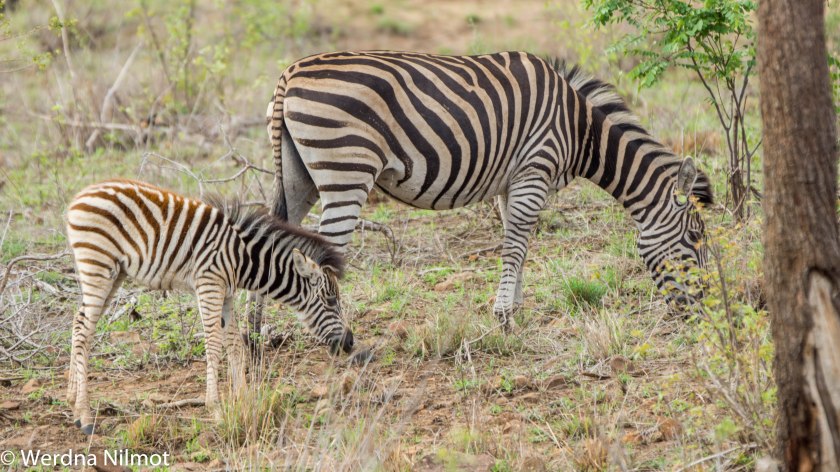
Our first game drive of the trip started well…we saw elephants a short while from Skukuza, along with the usual cast of characters…zebra, giraffe, antelope, kudu, hornbills, rollers, etc..  The ShopRite in Hazyview was well stocked and reasonable, at least in USD…a week’s groceries was $125.00 US, and included purchasing 2 soft sided coolers and ice packs.  We spent an additional $50.00 US at the Skukuza camp store for 6 bottles of nice ZA wine and 6 large bottles of still water.

dsc07121

(zebra mom and baby towards Phabeni Gate)

We returned through Phabeni Gate and continued to Skukuza, where we checked into unit 209, a GC6 chalet on the river, with 2 bedrooms and 2 en suite baths, on either side of a great room with nice kitchen, dining area and lounge area.  There is also a covered patio overlooking the river for al fresco dining.  The is the only GC6 cabin in Skukuza.  I’m sure that it gets booked quickly..we reserved it for the first and last night in January 2016 for our November trip. The cost was R2,320 ($178 +/- $US) per night before conservation fees.  We ate a quick, inexpensive dinner of grilled cheese sandwiches, french fries and still water at the Cattle Baron take away, before getting a good night’s sleep.  We planned to be out of the gate when it opened at 430 the next morning…

Day 2 – 19 November 2016

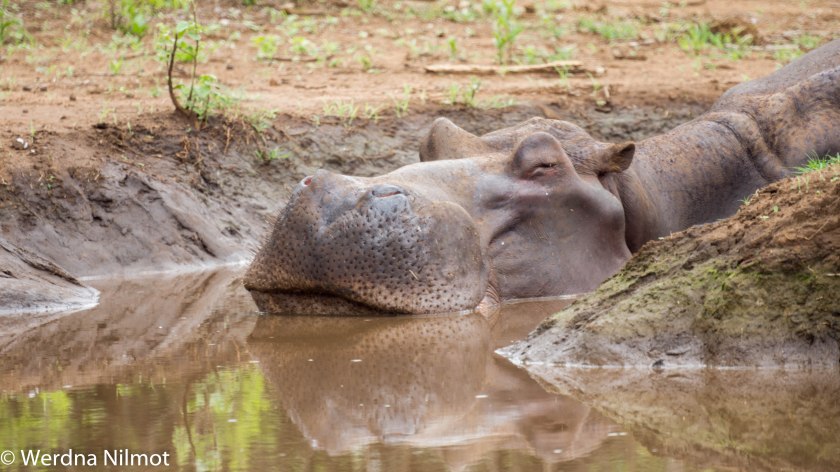
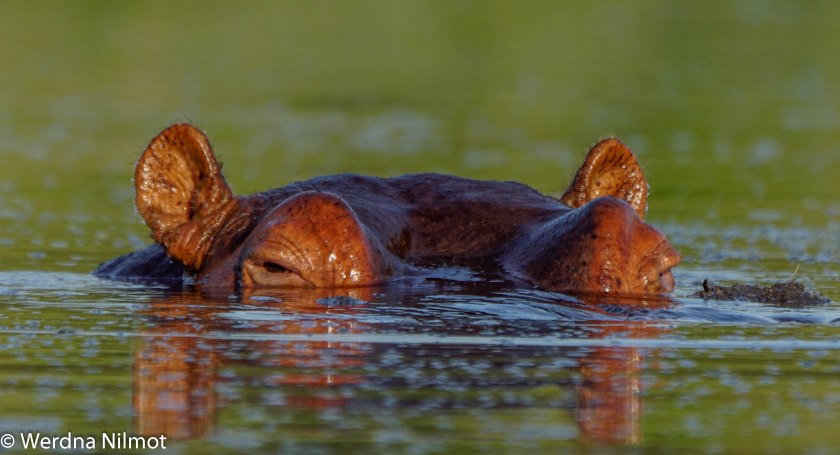
This was moving day…our transition from Skukuza to Biyamiti bushveld camp.  As the crow flies, Biyamiti is not all that far from Skukuza.  In fact, the most direct route is perhaps 50 km from Skukuza.  However, why take the most direct route, when you can spend a long, wonderful day driving though the Kruger, with potentially incredible sightings waiting for you around every corner.  Also, you must drive slowly, if you expect to see all that is around you.  On the tar (paved) roads, the posted speed limit is 50 kph (30 mph), and 40 kph (24 mph) on the unpaved roads.  That being said, if you drive at the speed limit, I suggest that you will indeed miss out on many potential sightings…the hippo below was tucked way back in a small water hole, and would probably have been overlooked had we been driving along at 40 kph…

dsc07189

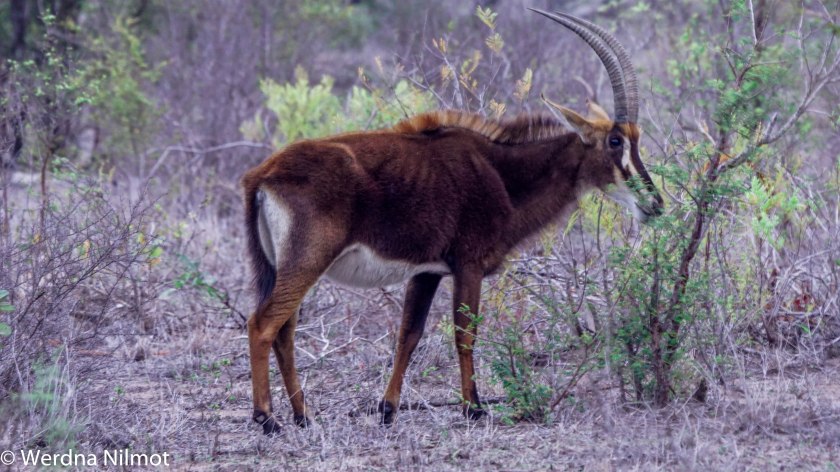
Our route took us out of Skukuza in a generally southwest direction to our first stop, Pretoriuskop Rest Camp, where we would have breakfast at the Wimpy.  We drove on paved roads all the way, averaging 30 – 35kph.  We again saw three of the big 5 – including elephant and cape buffalo, along with many other animals…the one highlight was spotting a regal, male sable antelope very close to Pretoriuskop.  According to park data, there are only perhaps 300 sable antelope in the entire park, so this was indeed quite a sighting!  Regrettably, he was very shy, and immediately took off behind our vehicle and across the road before we could get a shot off with our cameras….

dsc00209

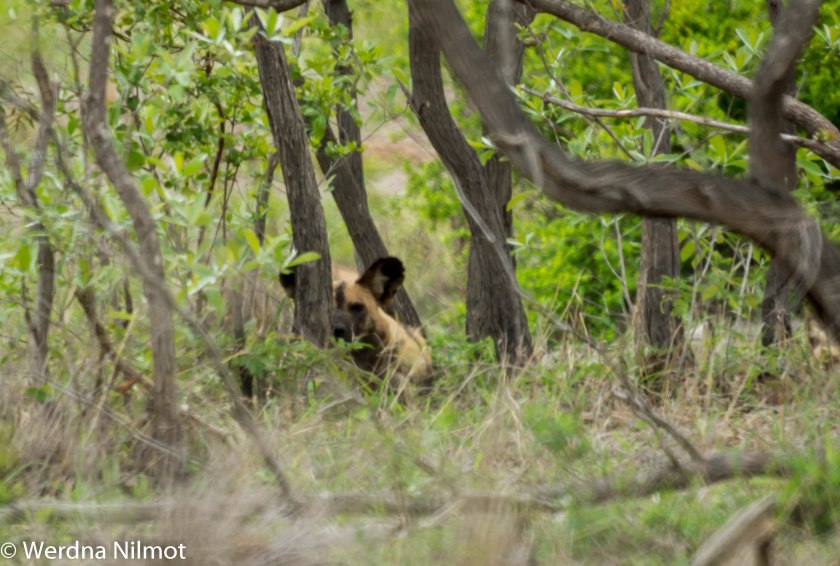
After a satisfying, if slow breakfast and pit stop at the Wimpy, we headed southeast on the Voortrekker Road , eventually aiming for the Afsaal Picnic Site around lunch time.  We actually passed the picnic site initially, and worked our way south towards Malelane, then looped back north.  A passing car told us of a pack of African wild dogs with a kill near Renosterpan off of the H3, about 5 clicks south of Afsaal.  We arrived there just before noon, and experienced our first traffic jam of the trip.  More than a dozen vehicles jockeying for position to see the 4 or 5 wild dogs perhaps 70 meters into the bush.  Occasional heads peeking up, a flash of movement.  We both managed some nice photos…

dsc07410

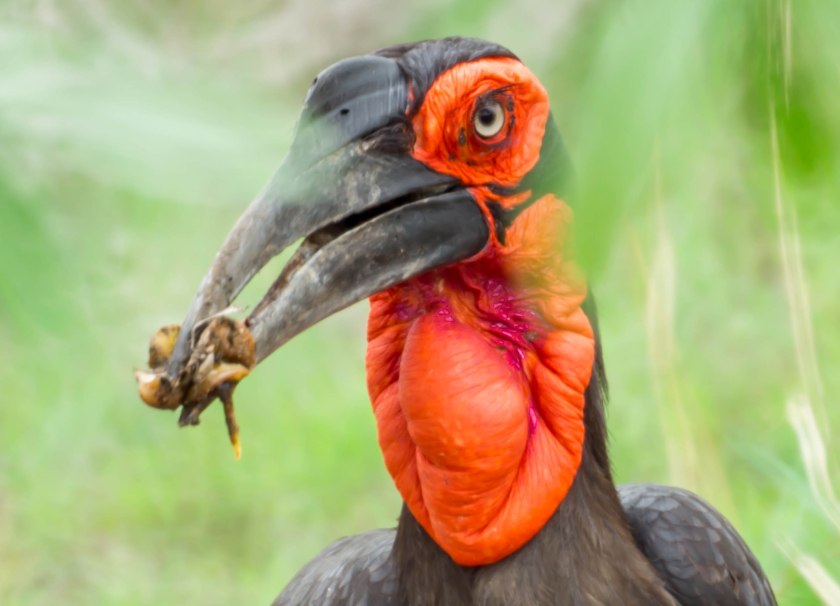
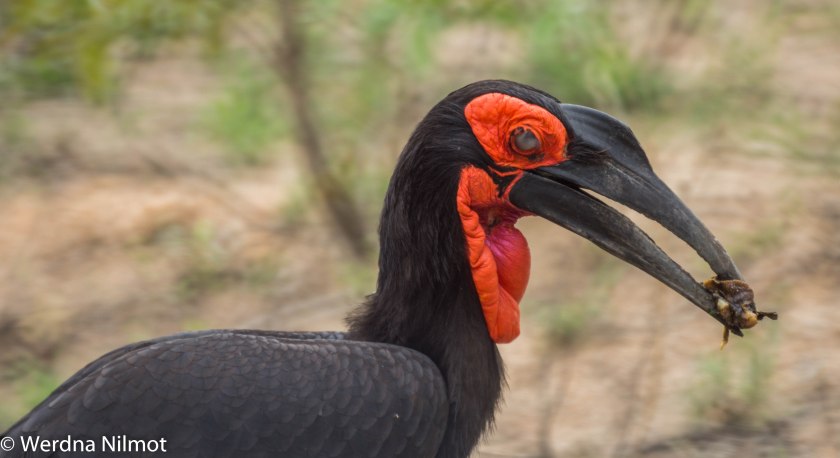
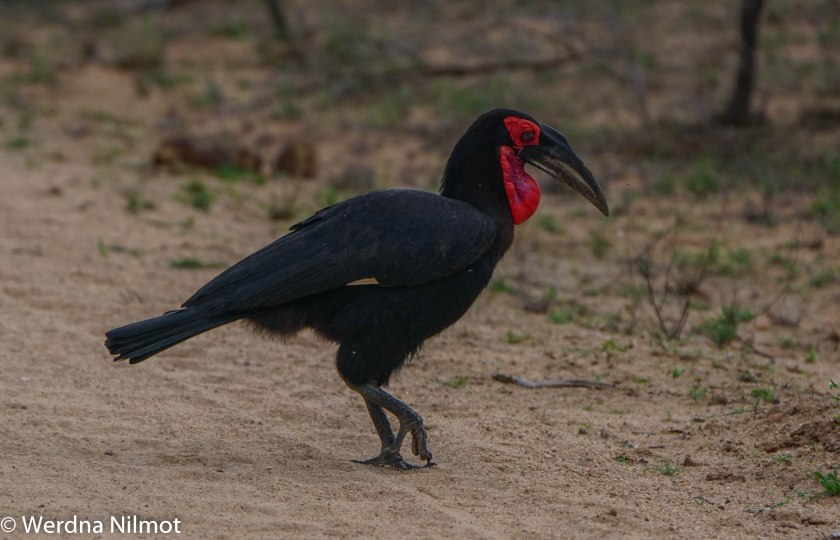
Tiring of the traffic jam, and the fact that the dogs were very hard to see, we proceeded further on towards Renosterpan.  We were rewarded by seeing a flock of a dozen or so southern ground hornbills, which proceeded to parade across the road in front of us.  We were the only car around, and managed to take some great photos of these fascinating avian friends…

dsc07385

dsc07395

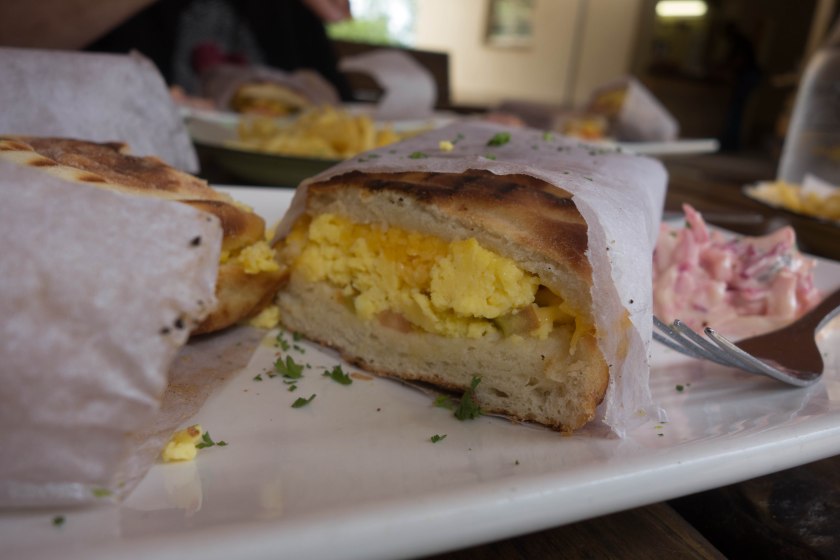
As it was getting well into the lunch hour, and our breakfast sustenance had long worn off, we headed north to the Afsaal picnic site.  We had read some unfavorable reviews previously, and recently some reported that the restaurant was under new management.  We are happy to report that the restaurant is quite good, and reasonably priced.  We did not see much vegetarian fare on the chalkboard menu.  We asked the nice young lady, and she said, “you eat eggs and cheese?”  “Yes”, we replied.  “Bush Toast”, she said, and smiled.  We ordered three bush toast, and a couple of bottles of still water.  Soon she delivered three of the largest sandwiches I have seen in a while, each with a generous portion of french fries and homemade coleslaw.  They were delicious…and very filling.  I finished one, and JET finished only half.  We asked for takeaway boxes for one order of fries and 1.5 sandwiches, which would be part of two future dinners…lunch cost R150 ($12 US) with tip…

dsc03067

(note: that is one sandwich cut in half on the plate in the background)
dsc03068

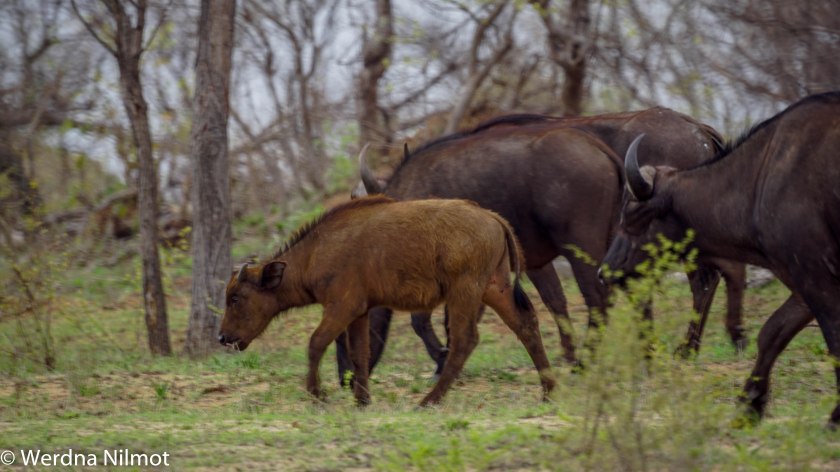
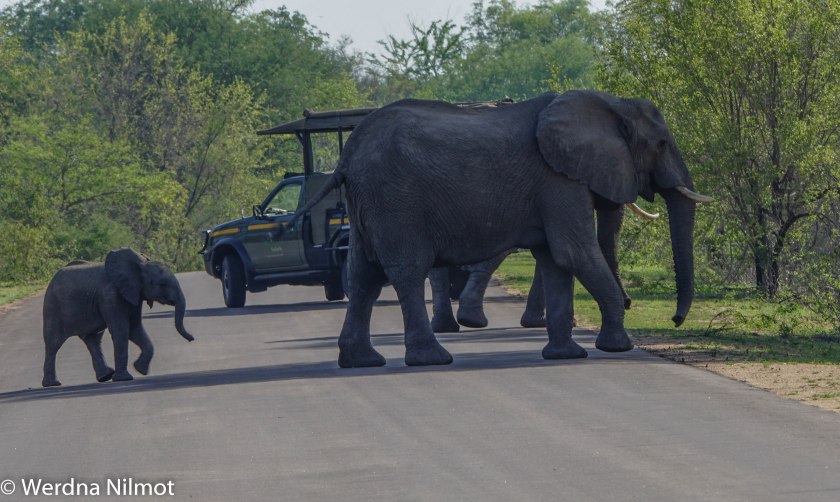
With full bellies, we pressed on to our final destination for day two, Biyamiti Bushveld Camp.  It is located on its own private access road, restricted to SanParks personnel and registered guests.  The road is sometimes referred to as the “Magic Road”, and it lived up to its reputation.  We saw many of the Big 5 on the 18 km of unpaved road to the camp, including a large bull elephant shortly after we entered the restricted road…

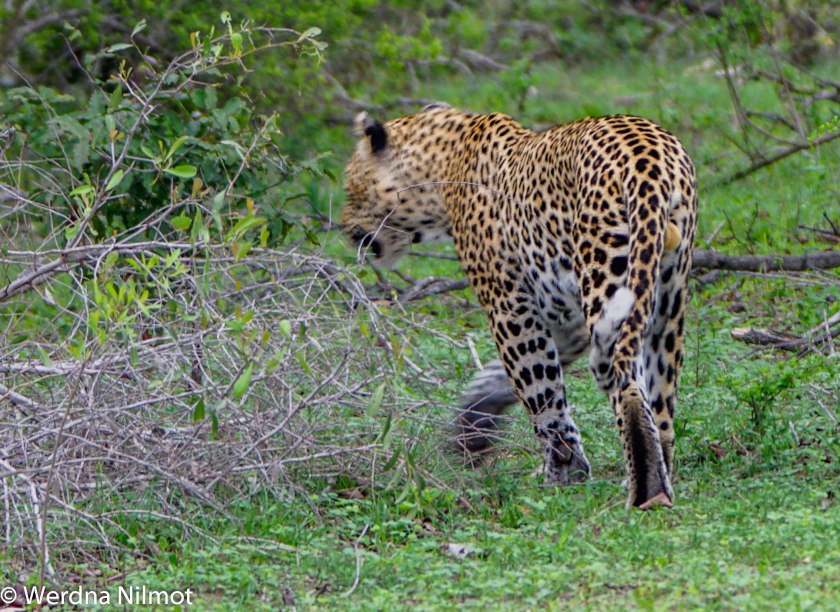
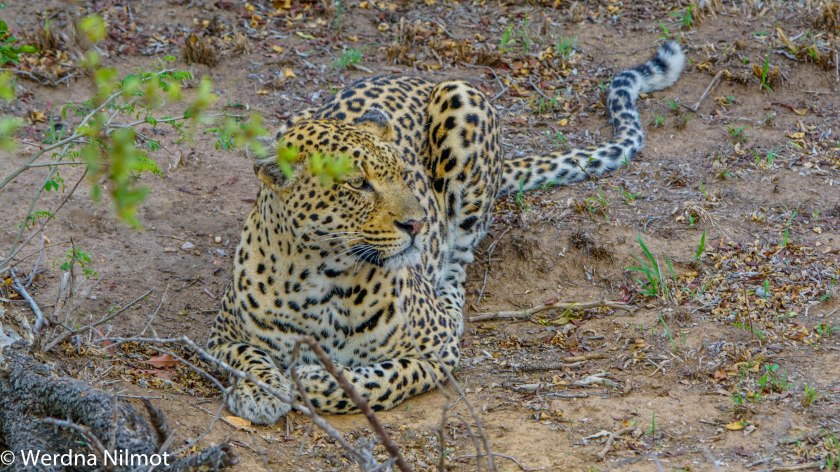
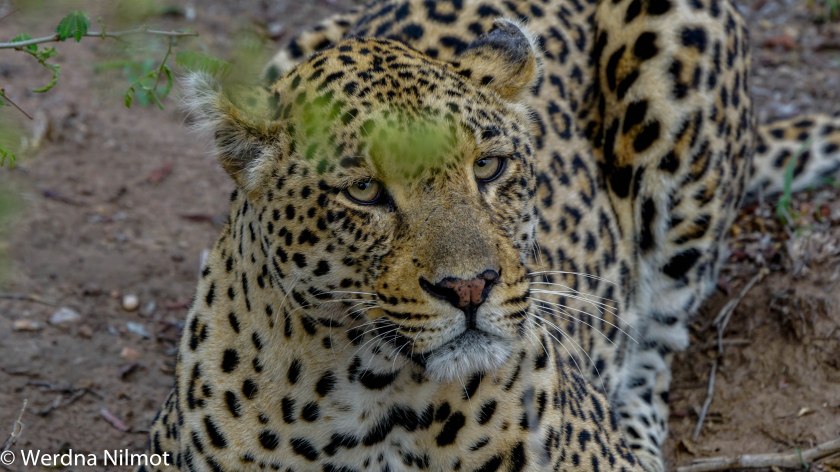
…and this fellow, a resident male leopard who surprised us as we rounded a bend, coming out of the bush right in front of our vehicle.  We were unprepared to get much more than “butt shots”, but what a sighting nonetheless…

dsc00774

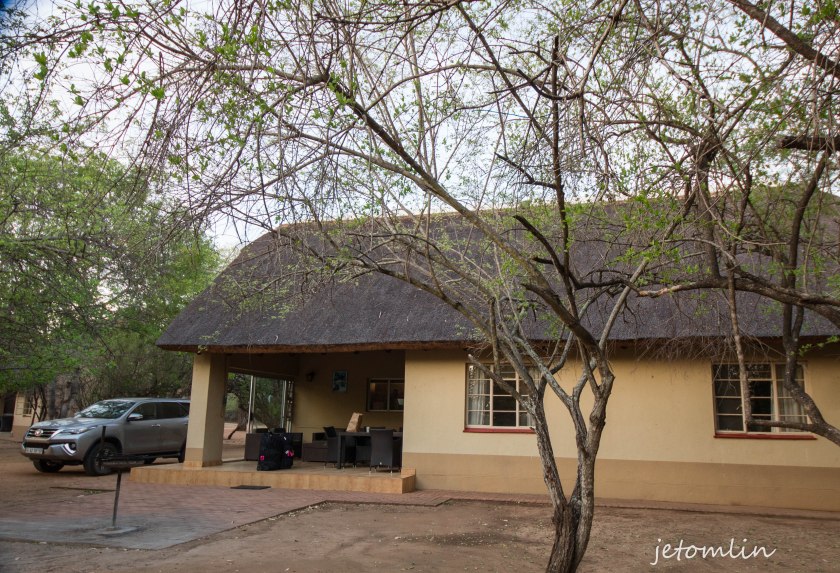
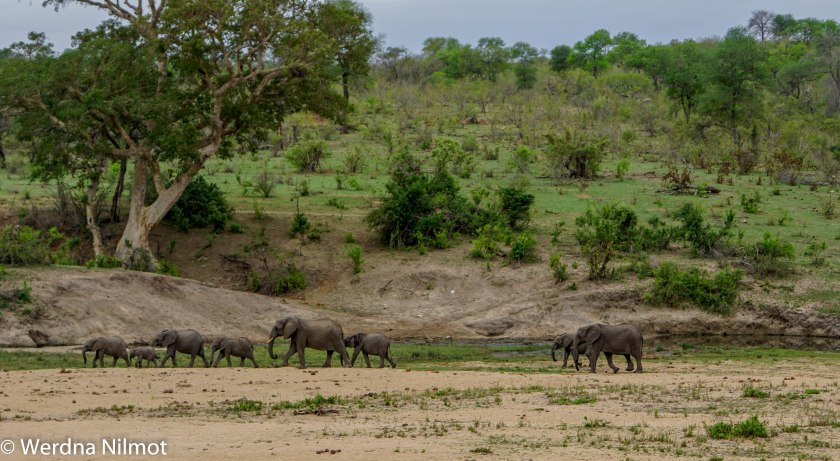
We checked into Biyamiti (unit #9), which sits on the banks of a (now dry) riverbed.  Our cabin was near a bird hide, and had an excellent location on the river.  We saw many different animals while staying there, including a splendid ellie family…

SONY DSC

Unit 9 at Biyamiti, with our trusty Fortuner

dsc00782

Ellie family in the dry riverbed looking from our cabin at Biyamiti

After unpacking, and confirming arrangements for our private, full day game drive the next day with reception and the ranger, we made a quick supper, and turned in for a good sleep.  The 3 AM alarm would come very quickly, so we would be ready to depart at 4AM.

Day 3 – 20 November 2016

SONY DSC

Sunrise from cabin 9, Biyamiti Bushveld Camp

Biyamiti is a world of peace and tranquility.  Have a listen to the camp before the sun rises…not much to see, but the sounds of the bush waking up are intoxicating…

In addition to the regular game drives and activities available at camps in the Kruger, private, full day game drives in a 10 seater with ranger can be arranged.  Costs seem to vary at each camp.  At Biyamiti, we paid R3,060 for two of us in a 10 seater.  Simon was our ranger/guide for the day, which started promptly at 4AM.  That is a benefit of arranging one of these drives…you can leave 1/2 hour before the camp gates open, giving you ample opportunity to see nocturnal animals, and beat other traffic to the roads.

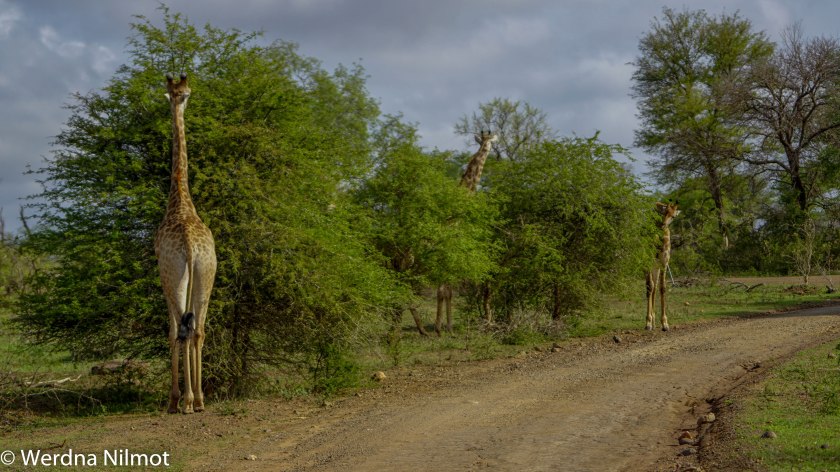
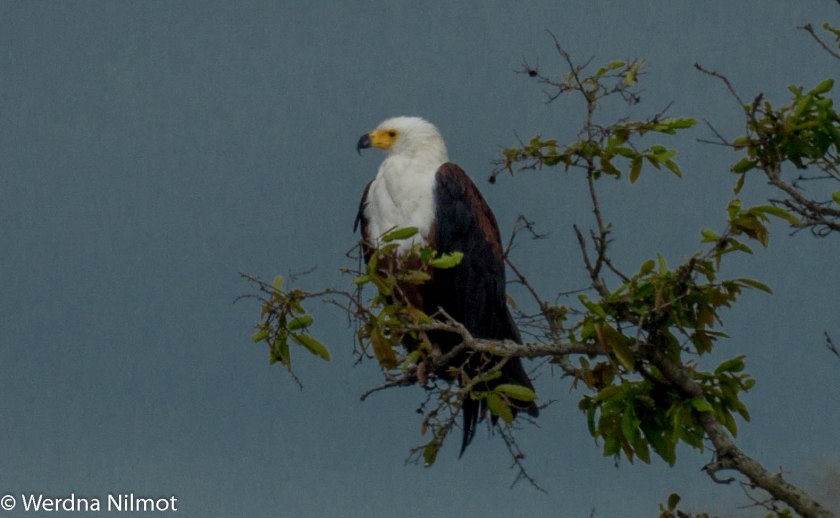
We saw many animals on the morning portion of our drive, including a nice group of giraffe and an African fish eagle in a tree 150 meters away…

dsc01158

dsc07693

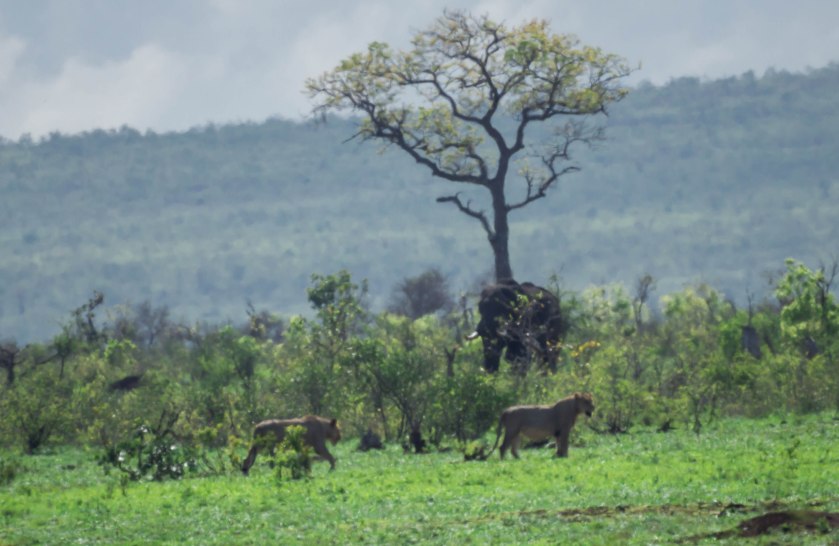
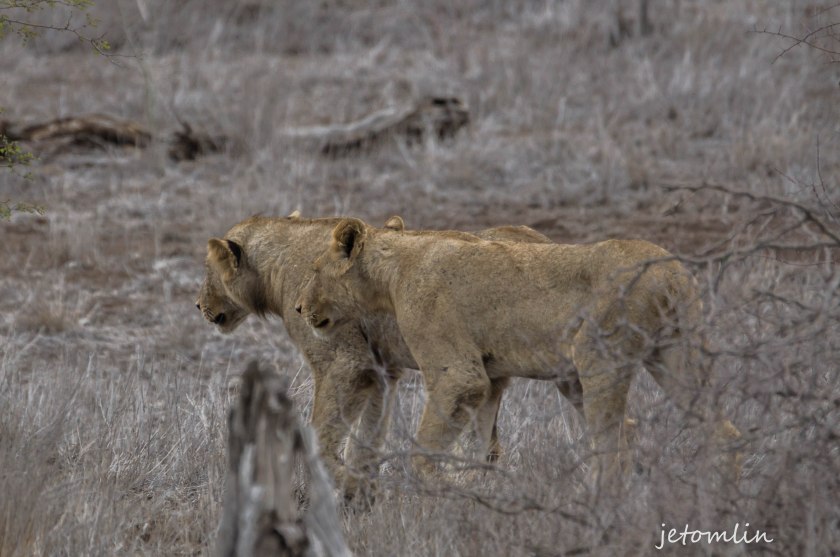
We slowly made our way toward Lower Sabie rest camp, taking the restricted access power line road.  This is cheetah country, with open areas they prefer.  We did not see any cheetah this day…we did see a group of 7 or 8 lions moving to shade a couple hundred meters away…

dsc07823

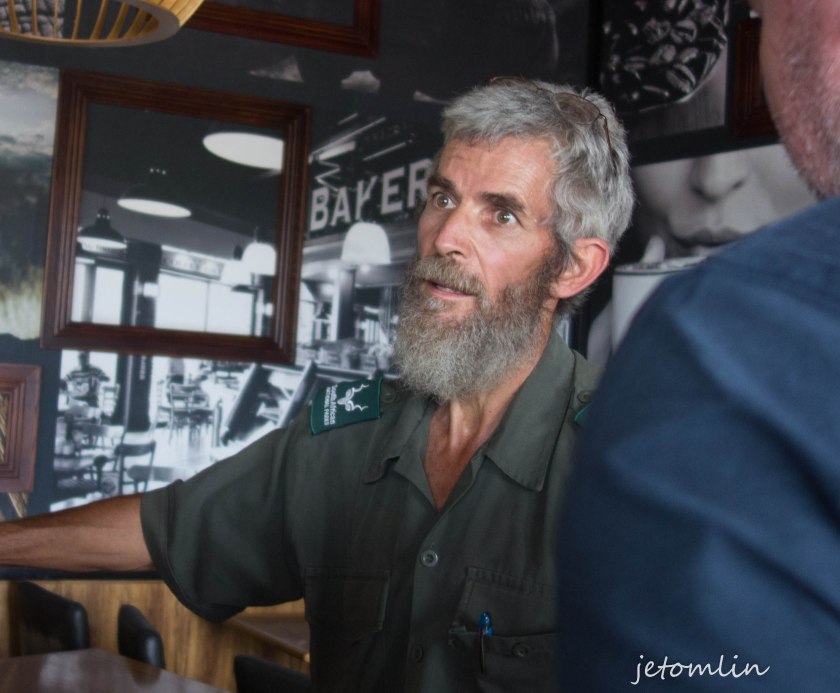
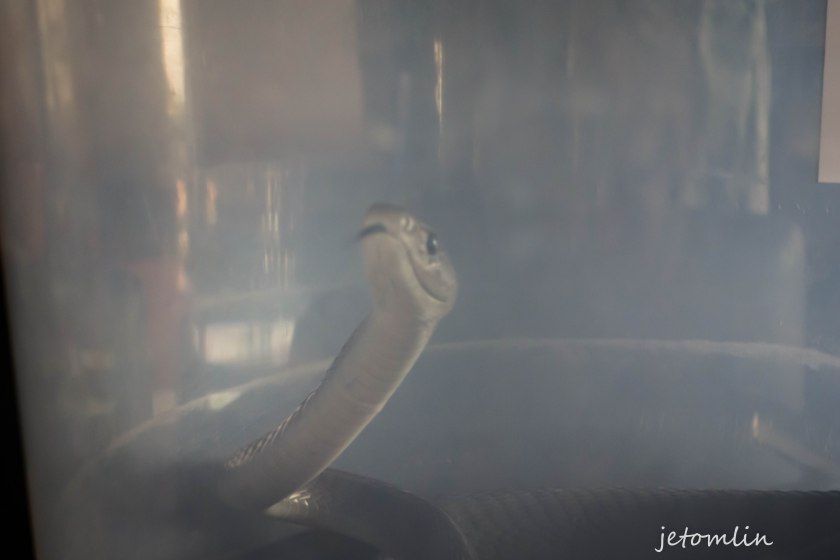
Our growling stomachs suggested that it was indeed time for lunch, so we stopped at Lower Sabie rest camp for a pit stop and lunch at the Mugg & Bean restaurant.  While there, we had some unexpected excitement.  Apparently, a deadly black mamba snake had found its way into the rafters of the restaurant.  Fearing that the snake might drop down on unsuspecting diners, the interior of the restaurant was evacuated, and all of the large sliding panel doors closed, effectively quarantining the interior of the restaurant while a snake wrangler was summoned.  Abdul, the snake wrangler, arrived a short while later, and had the wayward serpent safely in a plastic storage container within minutes.  He proudly posed for pictures and questions…

dsc03076

dsc03081

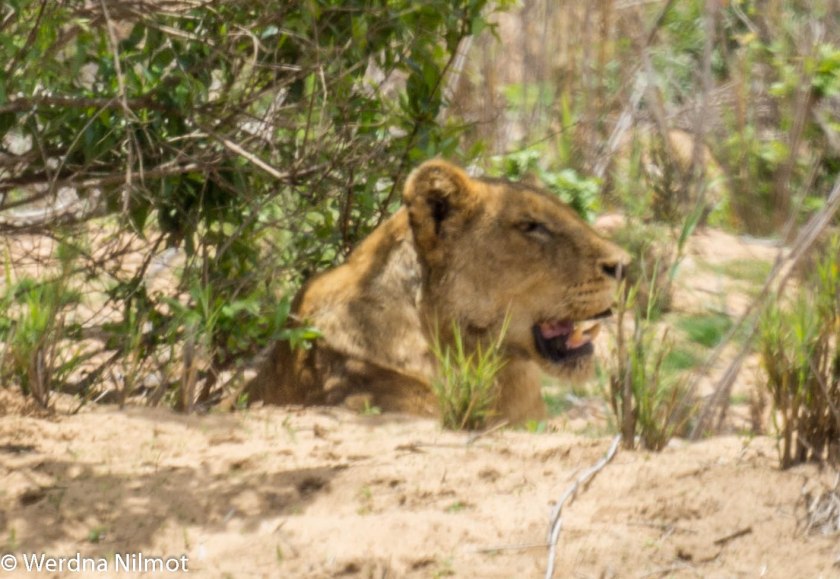
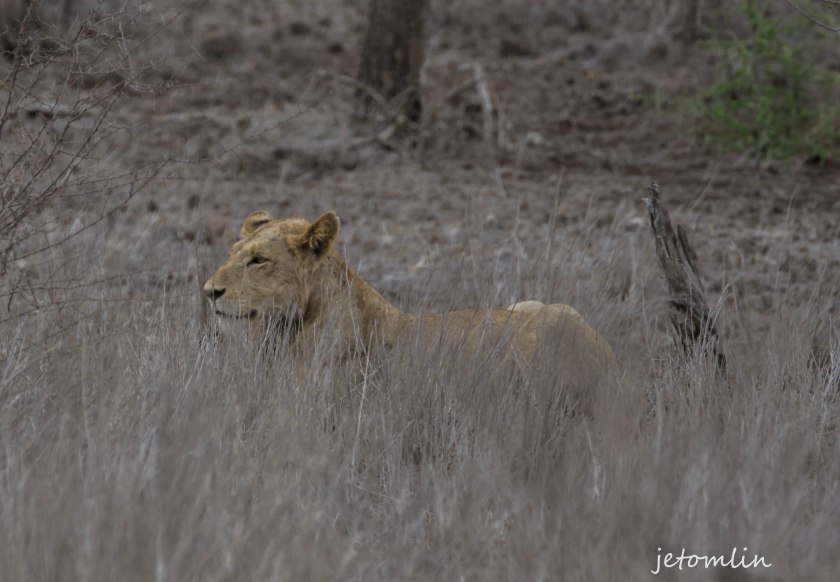
After lunch, we started heading back toward Biyamiti.  We had one more lion sighting, complete with requisite traffic jam.  Being in the heat of the afternoon, the lioness was comfortably in the shade, and 75 meters away, which made for tough shooting conditions…

dsc08032

We made it back to Biyamiti by around 4 PM, satisfied with another full day of exploring the Kruger.  After a nice dinner which included some of the delicious sandwiches from Afsaal the day before, we spent some time reviewing our photos from the last couple of days, and made it an early night so we would be up and at ’em for a 430AM start the next day.

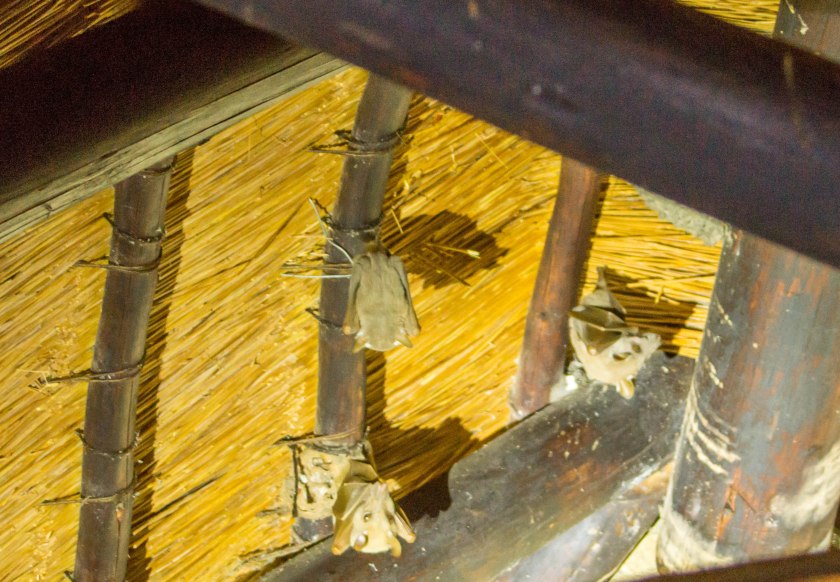
A note about Biyamiti….we would stay in this camp again, mainly due to the quiet location and privacy assured by the restricted road.  We would most likely choose a different cabin, though.  Ours (#9) was a 2 bedroom, which made it nice to spread out.  However, there is no place inside to sit down, other than on a bed.  The sit down furniture is all outside on the patio.  This can be inconvenient if the bugs are biting (they were), or if you are not fond of bats, which have nests in the rafters of the covered patio…just sayin…

_dsc1996

Day 4 – 21 November 2016

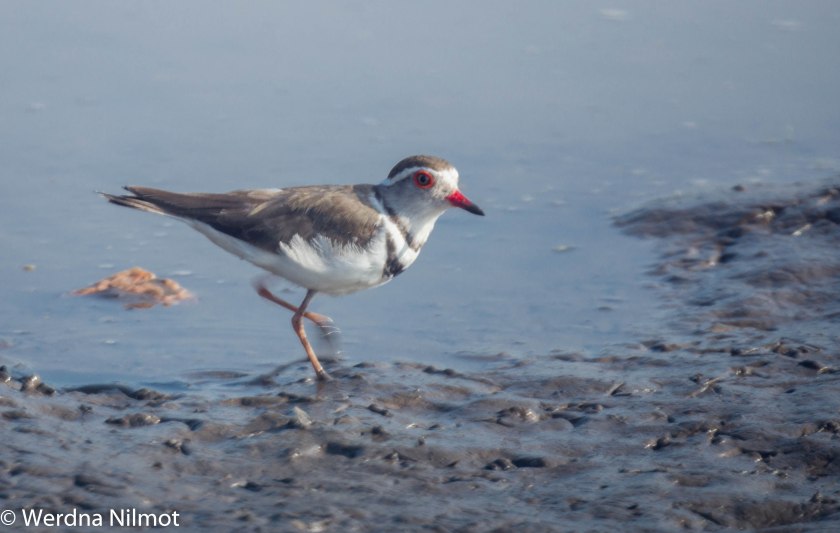
Day 4 started early, 430AM out the gate.  The morning was ordinary, if there is such a thing as an ordinary day in the Kruger.  Although we did not see many Big 5 animals before lunch, our slow drives did yield a number of sightings of some of the smaller denizens of the park:  a leopard tortoise, a three banded plover and a sand piper…

dsc08152

Three banded Plover

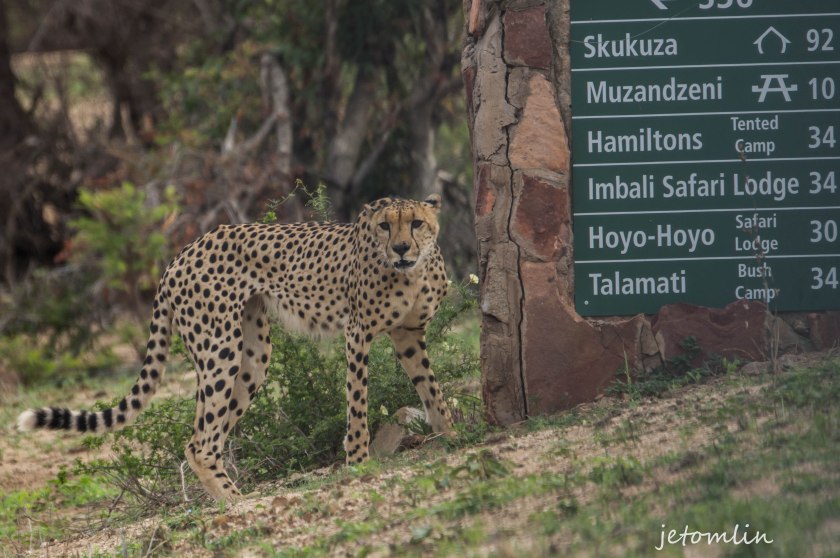
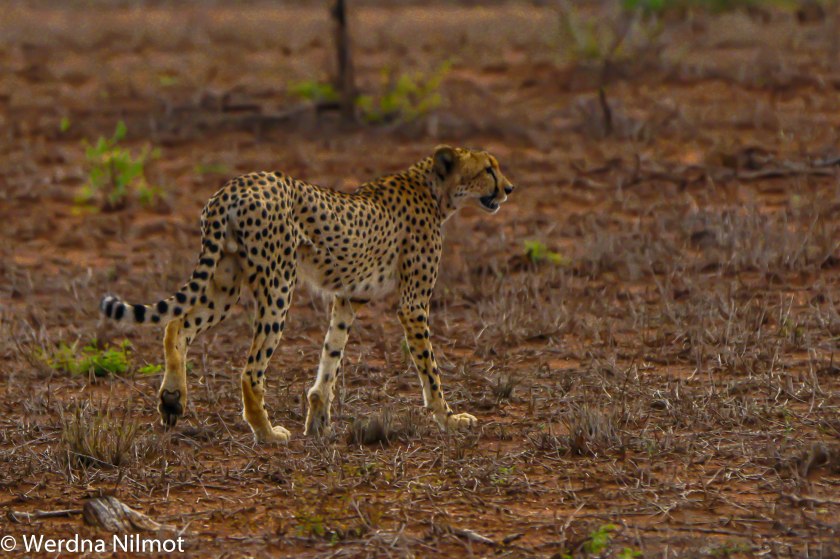
After fuel, coffee and a pit stop at Crocodile Bridge, we headed north, once again in cheetah country.  On our first visit to the Kruger in November 2015, we did not see any cheetahs or wild dogs.  Having checked off one of the two previously on this trip, our hopes were up.  Low and behold, we came across a lone cheetah lying quite well hidden in the shade.  There were three large ellies nearby.  At some point, the ellies moved closer to the large bush the cheetah was laying under, finally starting to rub their huge bodies against the bush.  With a look of “oh, for the love of Pete…”,  the cheetah abruptly stood and exited, stage right…

dsc01641

dsc01663

dsc01674

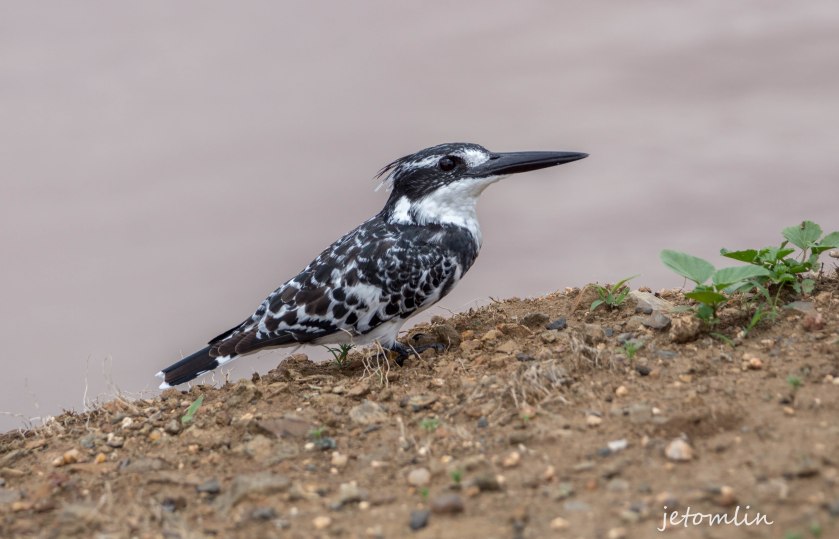
After a lunch break at Lower Sabie, we checked the sighting board for the day.  There were reportedly several lion sightings north of the camp, so we headed north, and stopped first at Sunset Dam for a look.  Not much in the heat of high afternoon, although a pretty Pied Kingfisher did make an appearance…

_dsc1433

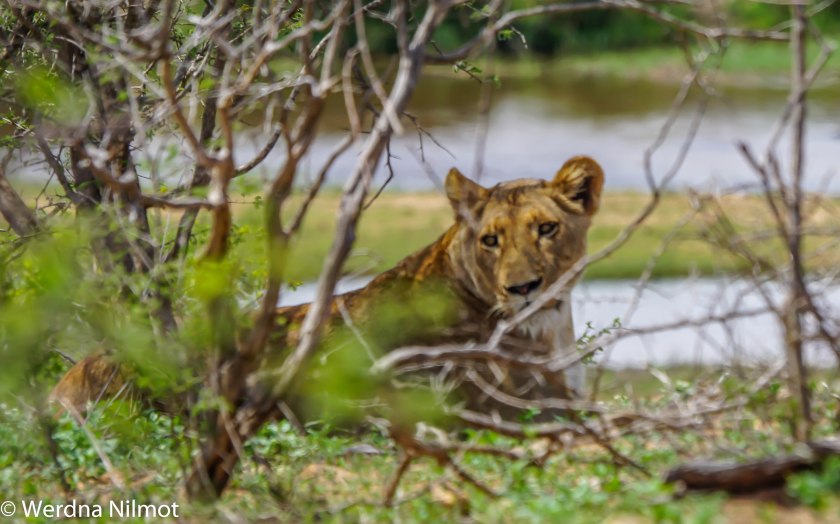
After leaving Sunset Dam, we came upon a small group of cars. We asked what they were looking at.  A woman said that there was supposedly a lion, but no one could see it.  Luck would have it that we were perfectly positioned for a few photos of the lioness, again some 50 or so meters from the road…

dsc01766

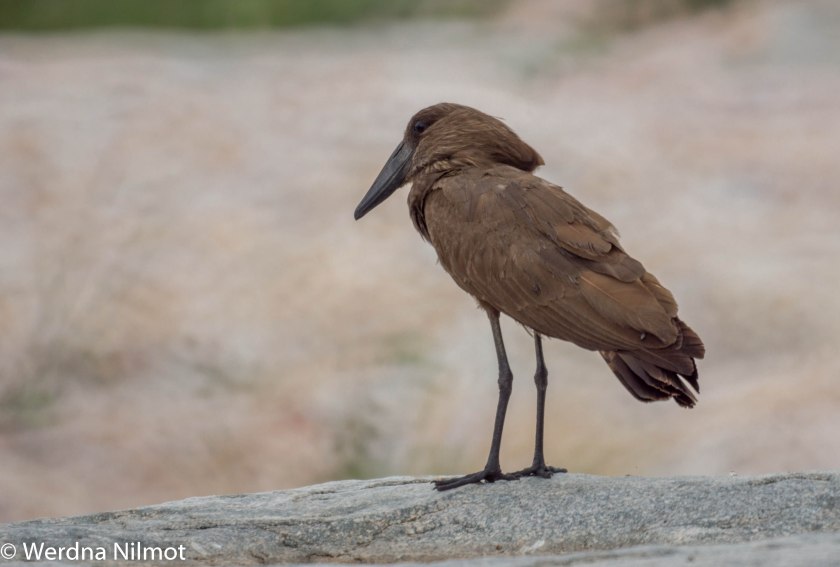
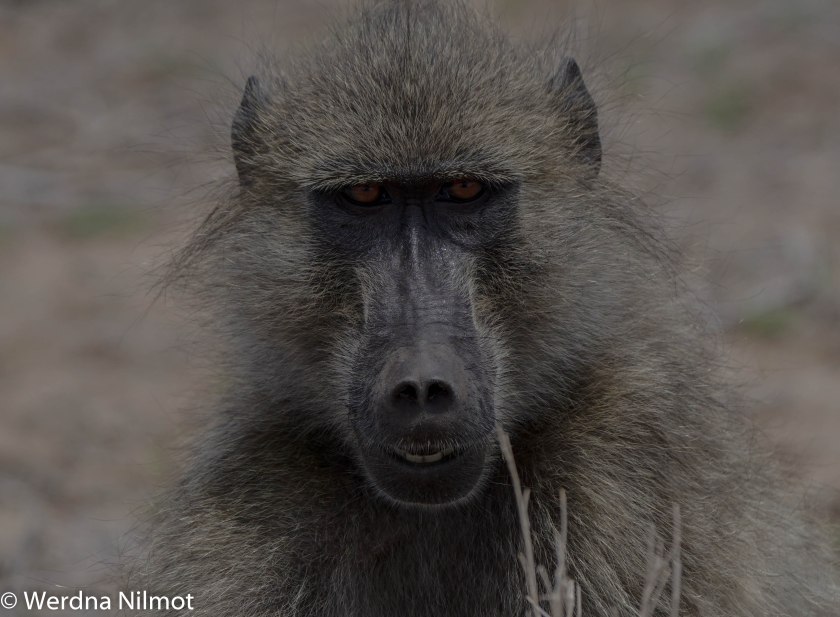
We had to get back to Biyamiti, as the afternoon was winding down, and we were tired from 12 hours on the road.  We did manage to see some kudu, baboons, a couple of crocodiles and one of my new favorite birds, a Hamerkop at a water hole very near the Biyamiti private road turnoff…

dsc01833

Baboon on the S114

dsc08094

Hamerkop near Biyamiti

Day 5 – 22 November 2016

Another moving day, since our 3 nights at Biyamiti were complete.  After a quick breakfast, we packed up the Fortuner and were out the gate by 430AM, heading north toward Skukuza.  Notable sightings along the way were a family of hyenas and a superb black chested snake eagle…

dsc02022

dsc02028

We stopped for a rest at Tshokwane picnic site, and checked the sightings board for any intel.  Pressing north with a destination of Satara rest camp for lunch, we encountered an ellie roadblock and hippos floating in the morning sun…

dsc01954

dsc02080

We made it to Satara for an extended lunch break.  After lunch and checking out the store, we again checked the sightings board.  A young man standing there told us of a leopard sighting at the intersection of the H1-3 and the S125 south of Satara.  Apparently, 2 leopards had a warthog kill up in a tree, with one leopard in the tree and the other on the ground.  We decided to head there, since it was in the general direction of Talamati bushveld camp, our home for the next 3 nights…

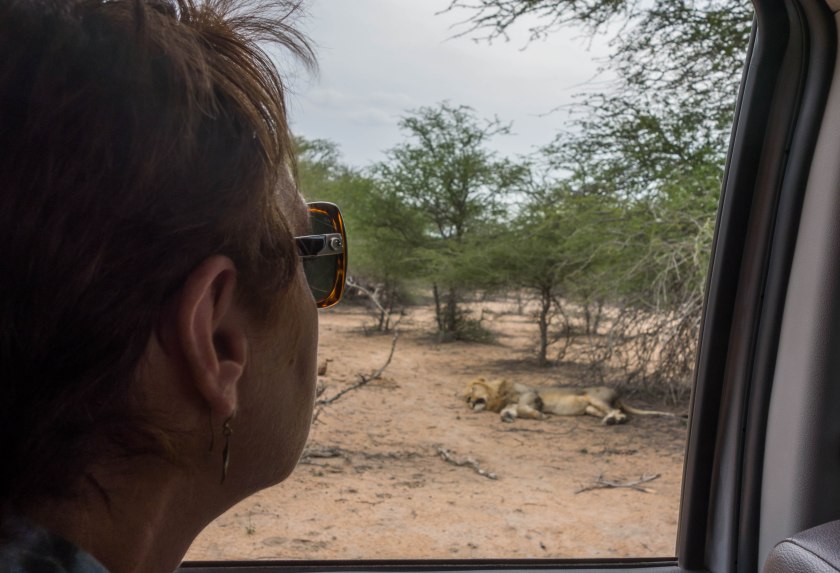
We arrived at the intersection of the H1-3 and S125 and…nothing…nada…zilch…certainly no trees large enough that looked like they would hold a leopard and warthog.  We drifted south a couple of clicks on the H1-3, and looked at a family of ellies under a grove of trees near a large water hole, and some hippos floating in the water.  After taking some more “ellie” photos (can you really ever have enough?  I think not), we turned around and headed back north to the S125, then headed west toward Talamati.  About a click off of the H1-3, I spied a large bird circling in the air.  I pulled over to try and shoot a pic for identification.  A car approached and stopped with sweeter news that I have never heard (at least on this trip).  “Reset your odometer…” said the man…. “drive exactly 12 kilometers from here…two male lions right by the side of the road, sleeping…they have been there all day…”Thank you…” we said.  “Any other cars?”  “No..” said the man, and he drove off.

Twelve kilometers is a pretty short distance, and it was quite possibly the longest we have ever experienced.  About half way to the sighting spot, JET says, “There’s a Kori Bustard…wanna stop?”  “I don’t think so…”  I said…”Kori Bustard vs two male lions right beside the road.  Sleeping.  I think the lions win..”  She agreed.

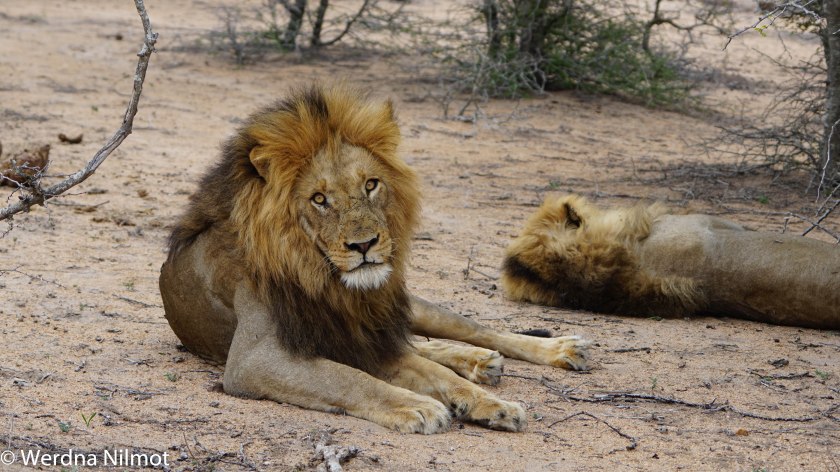
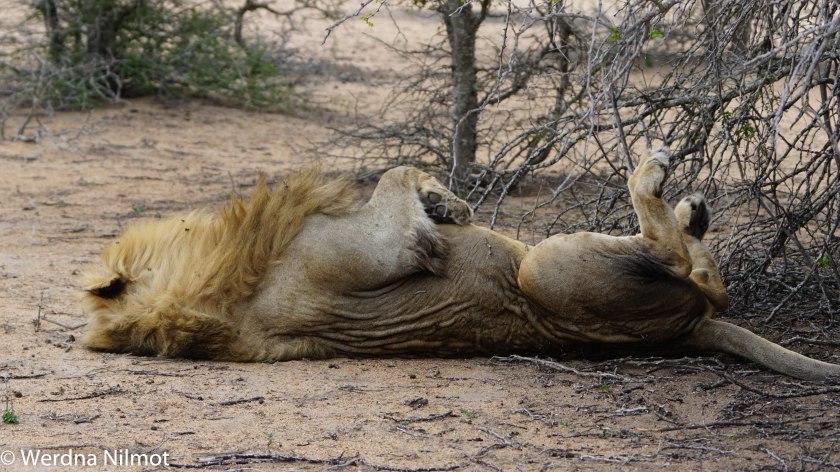
We arrived at the spot, and there they were, 5 meters from the road.  Only one other vehicle.  We spent an hour there, in absolutely elated awe.  What beautiful, noble animals.  We each took probably 100 photos, tack sharp, with perfect lighting.  There were never more than 3 vehicles there, including our own.  A 10 seater full of tourists arrived and stayed for 15 minutes.  One of the guys in the rear most row dropped a lens cap over the side.  I looked at him with a look that said “Looks like you’ll be shopping for a new lens cap…”

dsc03091

dsc00182

dsc00180

dsc00161

dsc00175

Post-trip note regarding this lion pair.  Sandmans, a destination expert for the Kruger Park on TripAdvisor, made the following comment after reading this report:

“most likely they are the Mluwati Pride, a coalition of two males residing around the S125, very handsome boys, one being darker maned and the other a little lighter…”

Thanks to Sandmans for the comment.  We could have stayed for another 3 hours with these spectacular fellows.  Sadly, we had to move on to make it to Talamati before the gate closing.   We knew that we had just been part of a rare occurrence, even for the Kruger, and our hearts were permanently changed that day…

Day 6 – 23 November 2016

We had arranged for a second private, full day game drive during our trip, this time from Talamati.  Driving for 12 – 15 hours every day definitely takes its toll.  If you are an avid photographer, it can be doubly tiring.  Our ranger/guide for this trip was Eulandah (Yo-lahn-dah), one of a handful of female Sanparks rangers.  She picked us up at 4AM sharp, and we set off.  Slowly.  20kph slowly, about 12 miles per hour, no faster than a leisurely bike ride.  I thought that her speed was because it was still dark.  I was wrong.

We saw a honey badger digging in the predawn darkness less than a click out of camp, but our pictures did not come out well…too dark.  We saw another rare sable antelope in the darkness, and this time had photos to prove it…

dsc00219

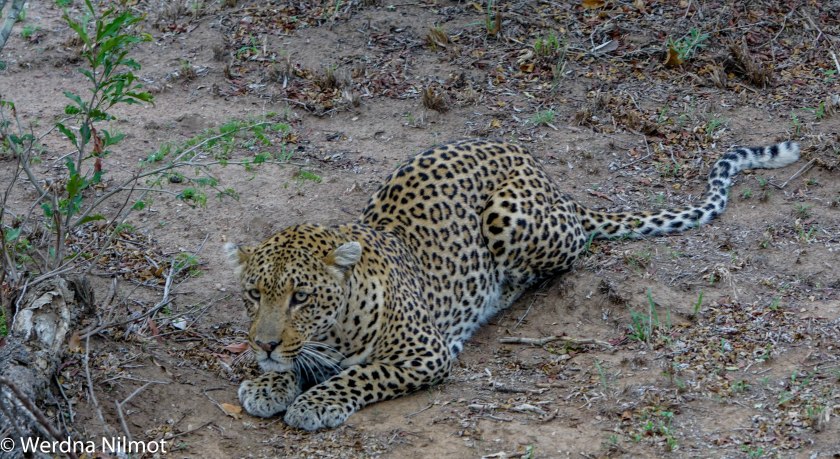
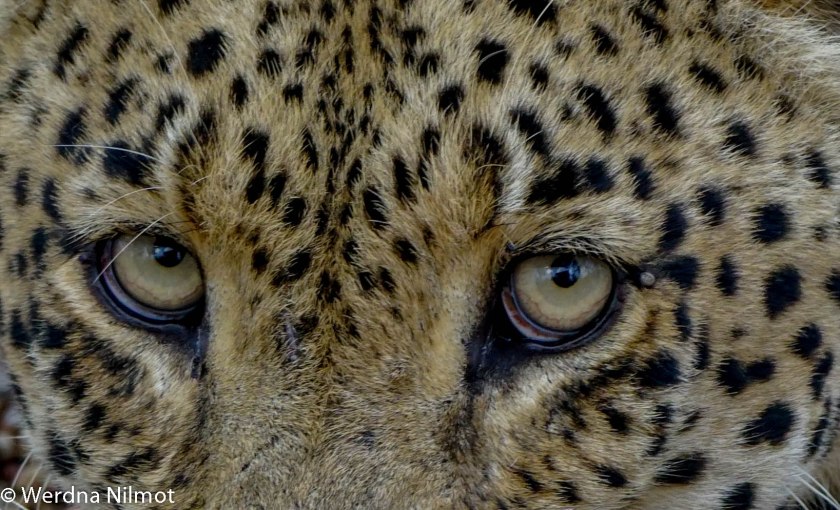
We passed the sacred marula tree just before the junction with the S36 and then turned south.  Creeping along, slowly but surely, watching the Kruger awaken before our eyes.  Eulandah was economical with her words, but they were effective.  She abruptly stopped the 10 seater.  “Leopard..” she whispered, and pointed.  We looked to our right, and saw nothing in the early morning light.  “Look down…” she said.  And there it was, right below us, and 5 meters from the vehicle…a beautiful leopard, lying crouched, staring intently at a nearby drainage culvert.  A second crazy good sighting of one of the Big 5 in as many days, and not another car in sight.  We spent 30 minutes with this handsome boy…

dsc00249

dsc00250

dsc00233

dsc00245

“Let’s see what else the bush will show us today…” said Eulandah, as we slowly drove away…

We headed toward the spot where we had seen the Mluwati lions the day before, hoping that they might still be around.  When we arrived at the spot, the lions were no longer there.  However, another large leopard surprised us as it crossed the road and disappeared into the bush.  Two different leopard sightings in less than an hour…..incredible…

dsc002631

As we moved south towards Tshokwane, our first pit stop, we were still moving at 20 kph.  On the tar road.  Cars buzzing by us.  I was a little frustrated.  My urban USA impatience was vying for control.  I suppressed it, hearing her words again.  What will the bush show us?

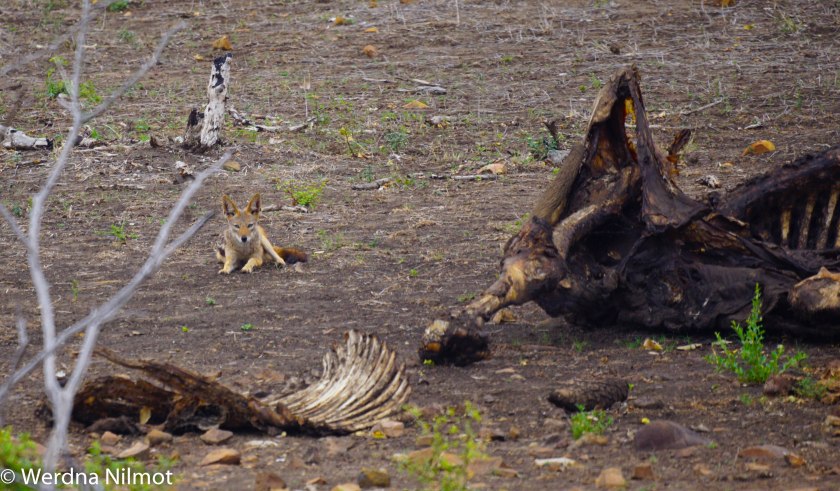
Up ahead, Eulandah gently stopped and pointed to a huge, well cleaned carcass, probably an elephant.  “Jackal…” she said and pointed.  We saw it, but the other drivers cruising at 50 kph surely missed it.  A black backed jackal cleaning up the remaining scraps of a kill..

dsc00305

dsc00306

We continued on, seeing waterbucks, wildebeests, and many other animals.  We stopped at Tshokwane for a break.  We had now been on the road for 5 hours.  One does not travel very far, very fast at 20 kph.  And that’s the beauty.  My paradigm shifted that day, and I thank Eulandah for it.  From that moment on, we never approached our game viewing in the Kruger the same.  Slow and steady…the tortoise wins the race.  We even saw our third leopard sighting of the day: sleeping beside the road.  There was a huge traffic jam, so we moved on after a few minutes…

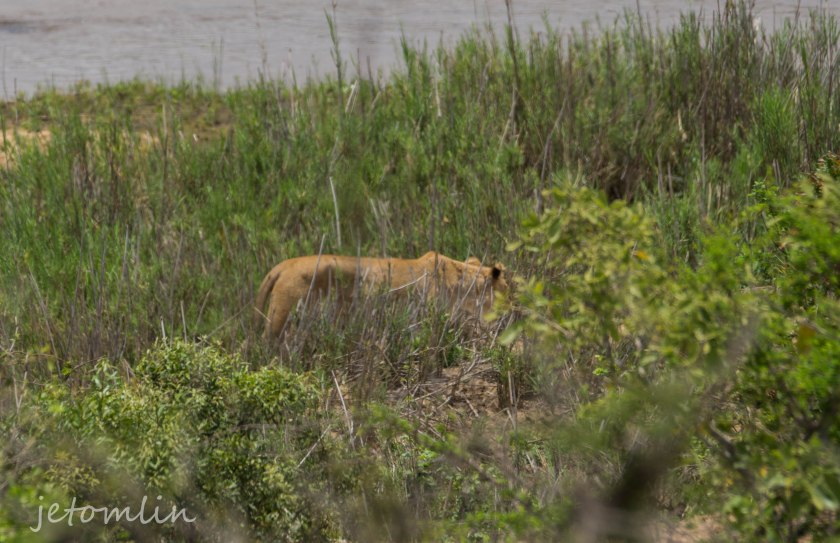
We finally made it to Skukuza, and one of Eulandah’s guide friends told her of a lion sighting near Nhlanganeni, a little to the south.  We slowly motored our way down there and finally saw the traffic jam, and it was epic, even for the Kruger.  The vehicles were 3 and 4 deep in places, all trying for a better position.  We finally saw the cats, about 100 meters away, and they even started to run along the river bank.  Eulandah was courageously trying to work into a better viewing position, and we stopped her.  We have seen the lions, and we don’t want to be part of this jam-up…it’s OK to move on, we told her…even so, we managed a few shots…

_dsc2712

After a lunch of tasty veggie sandwiches at the Skukuza Golf Club restaurant (included in the price of the full day drive), we set out to the north and Talamati.  It was now about 2PM.  At this speed, we would most certainly not be anywhere near the camp by 630PM gate closing.

“There’s still time…”, she said…

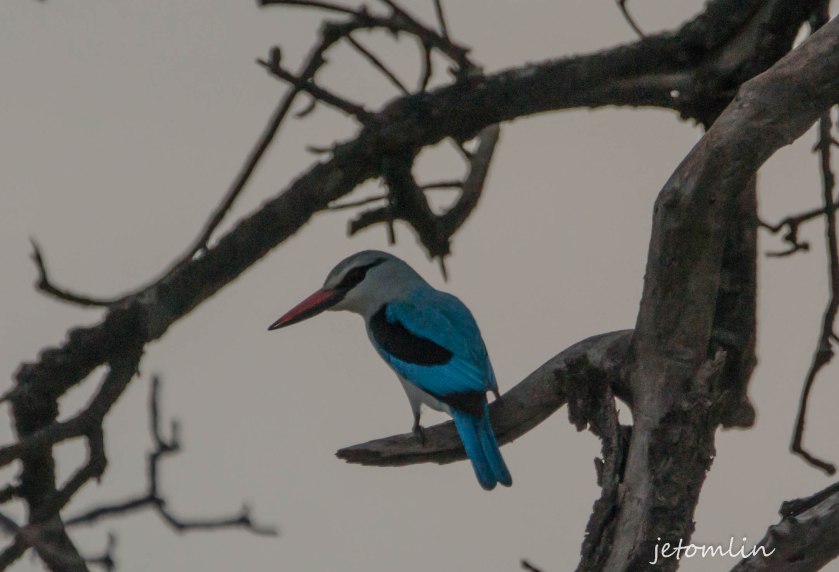
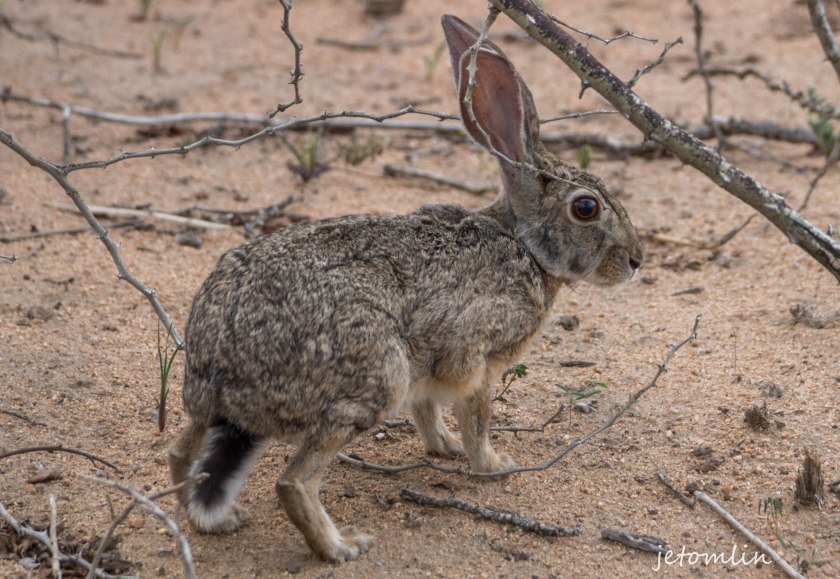
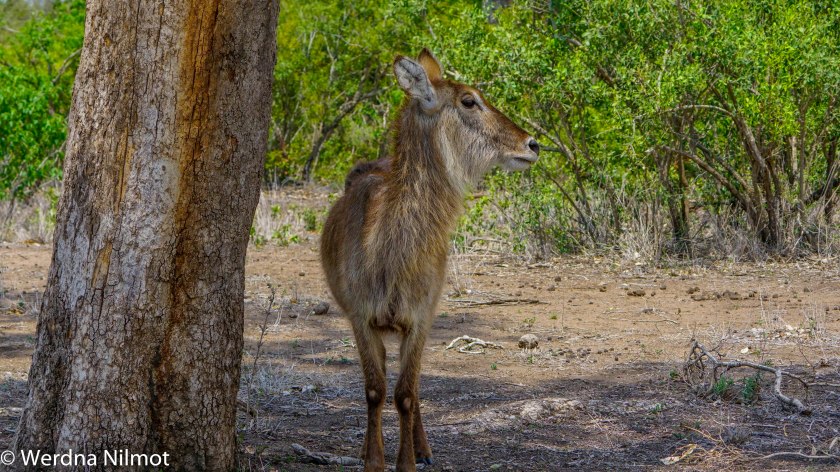
Over the next 5+ hours we saw a boatload of animals.  We had started to keep track of unique species sightings, and the number of sightings.  By the time we left Skukuza, we were up to 25 different species, some with multiple sightings.  We saw zebra, giraffe, hyenas, buffalo, scrub hares, kudus, many birds including a stunning woodland kingfisher and a hippo out of the water as dusk approached…

dsc00365

_dsc2759

_dsc2793

Exhausted and elated, we finally made it back to Talamati, well after dark, and well past the gate closing.  We used the same spotlights on our approach as we had to begin the day, over 15 hours earlier.  No honey badger or sable, but we did see the tell tale glowing eyes of bush babies in the trees as we slowly drove past.  We thanked Eulandah for a stupendous day, one in which we saw the complete Big Five, most of them of them multiple times, and learned how to truly enjoy the bush…

Day 7 – 24 November 2016

Back behind the wheel after the epic day before, I was excited as we pulled out of Talamati at 430AM for another game drive.  Slow and steady no longer seemed to drag.  We immediately started to track our sightings, JET dutifully recording them as I called out “Impala…mark it a 9, dude…”.  We encountered several foot patrols and a truck patrol of armed rangers on anti-poaching duty.  Comforting to see, given the poaching problem in the Kruger.  We spotted a lone southern ground hornbill crossing the road ahead.  The light was perfect…

dsc00373

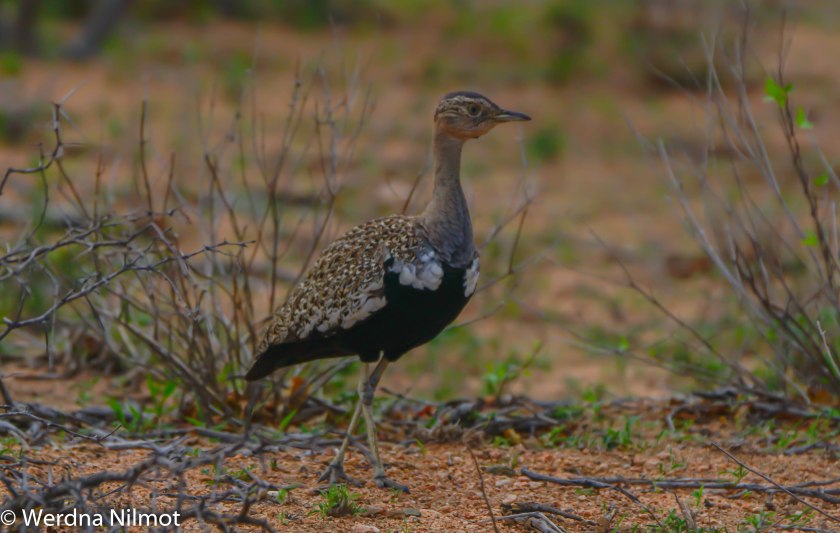
After a while, we heard the clarion call of a Red Crested Korhaan, the bird well known for its bizarre mating ritual of flying straight up into the air 30 feet or so, then contorting itself into a football shape and dropping dangerously close to the ground before coming out of the fall and gliding to a stop.  We saw one do this a year ago.  The one we saw this morning would not put on a show…

dsc00378

As the sun really started to rise, we saw something crossing the road ahead.  Perhaps 4 or 5 vehicles were there watching. Another cheetah!  We spent about 15 minutes watching it pace back and forth across the road.  We both took some great photos…it was truly breathtaking to see him lope across the ground…

_dsc2874

dsc00392

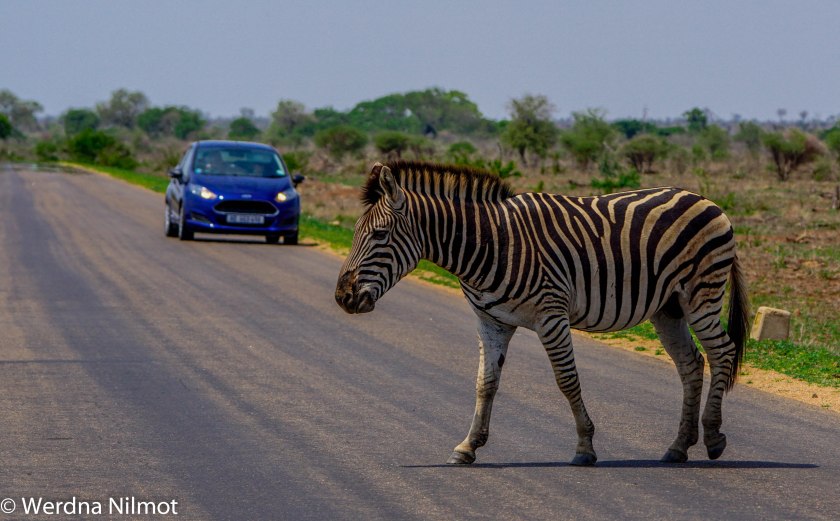
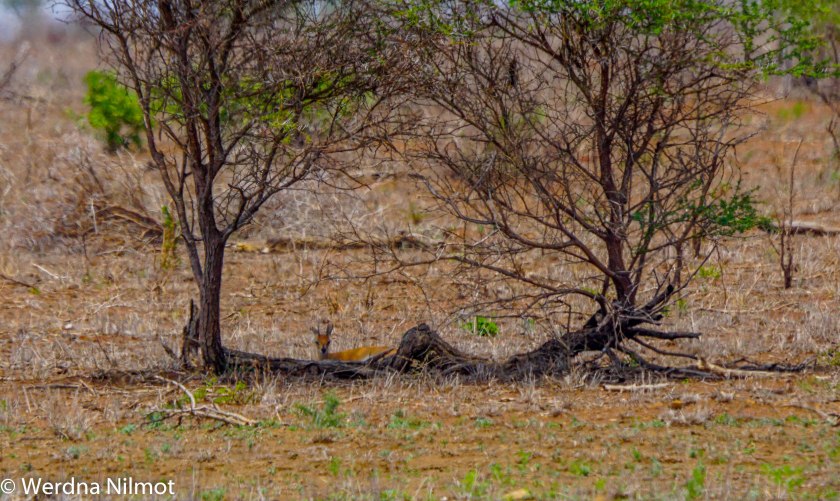
We continued on our journey that would next stop at Satara for an extended lunch break, and give us a chance to plug in for a couple hours.  Talamati is a beautiful camp, but you are unplugged.  Again, we were marking down all of our sightings.  Zebra crossing?  Check.  Wee steenbok cleverly hiding under a far away bush?  Check…

dsc00401

dsc00403

After our lengthy lunch/rest, we headed back on the road toward Talamati.  The sun was high.  We checked out a lion sighting near Satara…another traffic jam including some of the biggest tour buses we have ever seen.  We quickly nixed the plan and reversed our steps, seeing more baboons and waterbuck on the way…

dsc00422

dsc00424

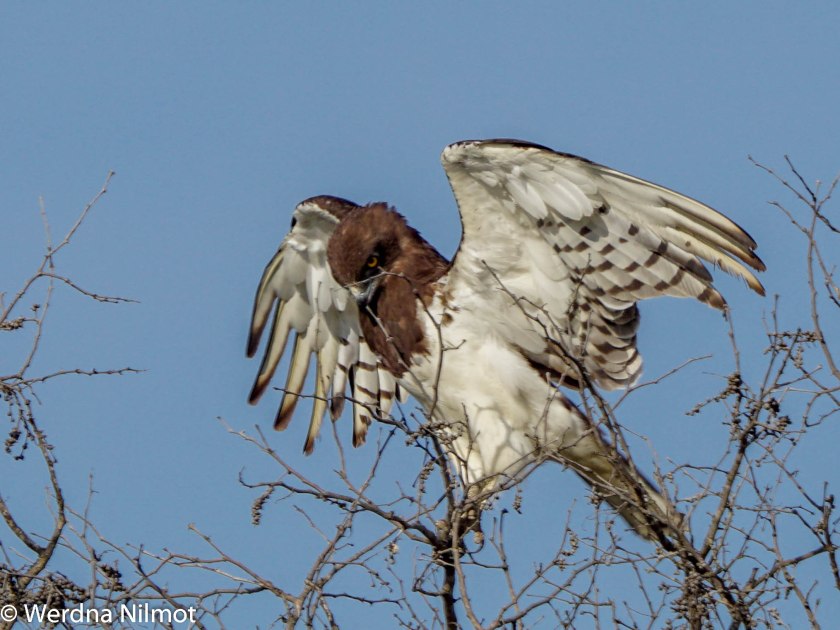
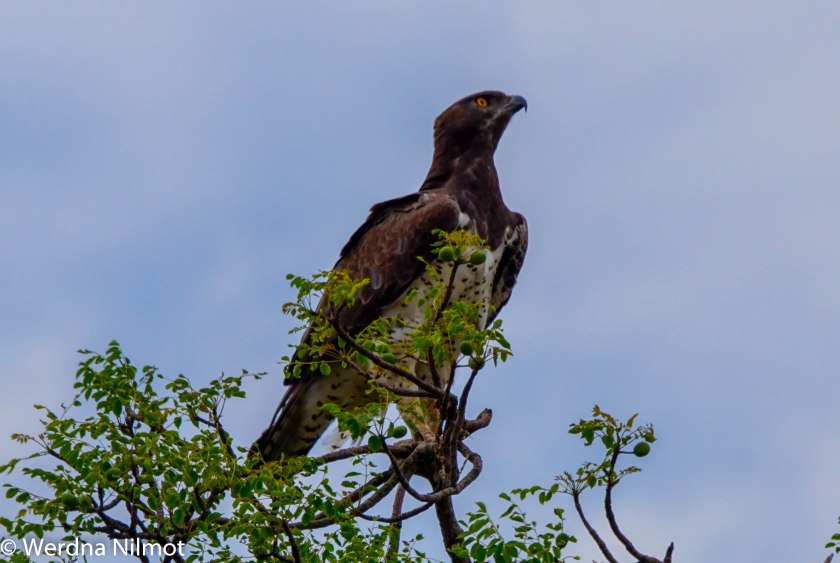
As we approached our turn onto the s125 toward Talamati, we spotted a beautiful martial eagle high up in a tree.  The lighting was less than ideal, but nonetheless a splendid sight…

dsc00438

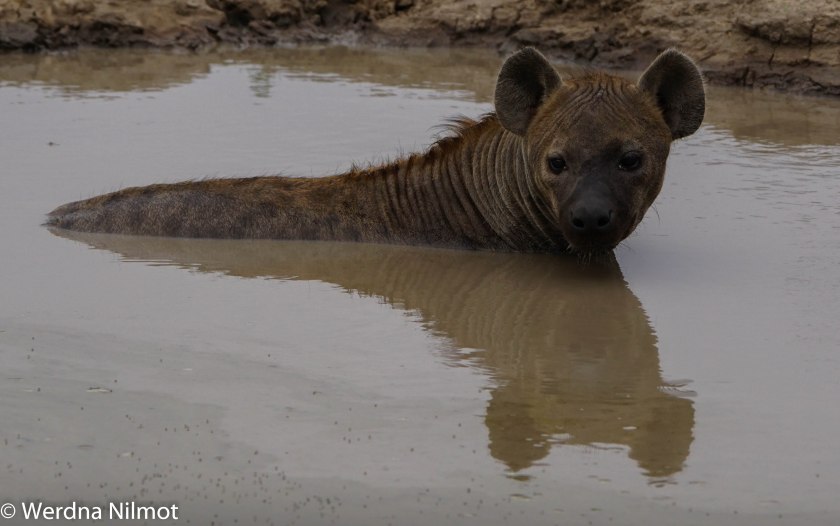
We wound our way west on the S125 in the fading afternoon light, JET saw a lone hyena making its way to a nearby waterhole.  The dappled afternoon light made for some nice photos as it took a bath…

dsc00455

Today’s count:  32 species, half of them with multiple sightings.  We packed up our bags and partially loaded the Fortuner, then had one last dinner at Talamati.  Tomorrow would be our last full day in the Kruger, and another moving day, back down to Skukuza.

Day 8 – 25 November 2016

Days 5 – 7 had been off the charts successful.  We had so completely eclipsed our first visit a year ago, which was in itself a great trip.  Now, as we said good bye to Talamati for the last time, we were beginning to set our sights on Skukuza, and preparing for the long journey home to Miami the next day…

And then this greeted us…

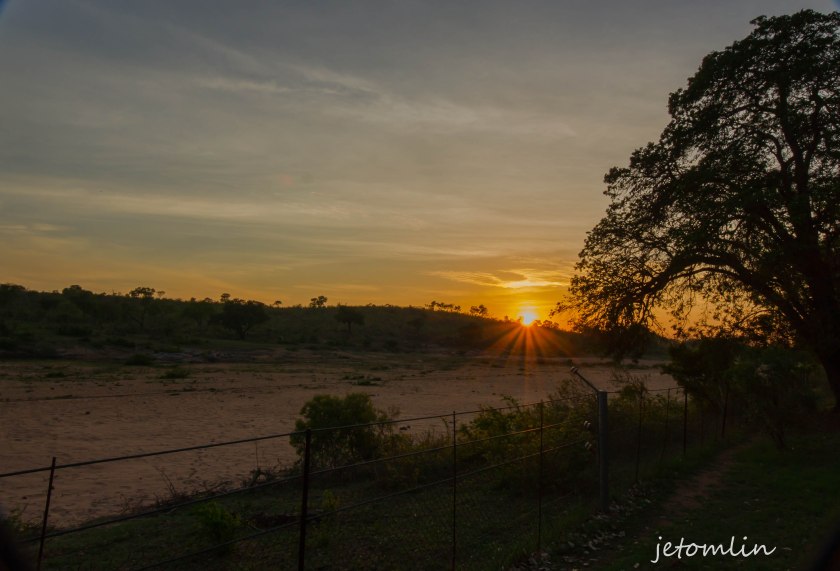
SONY DSC

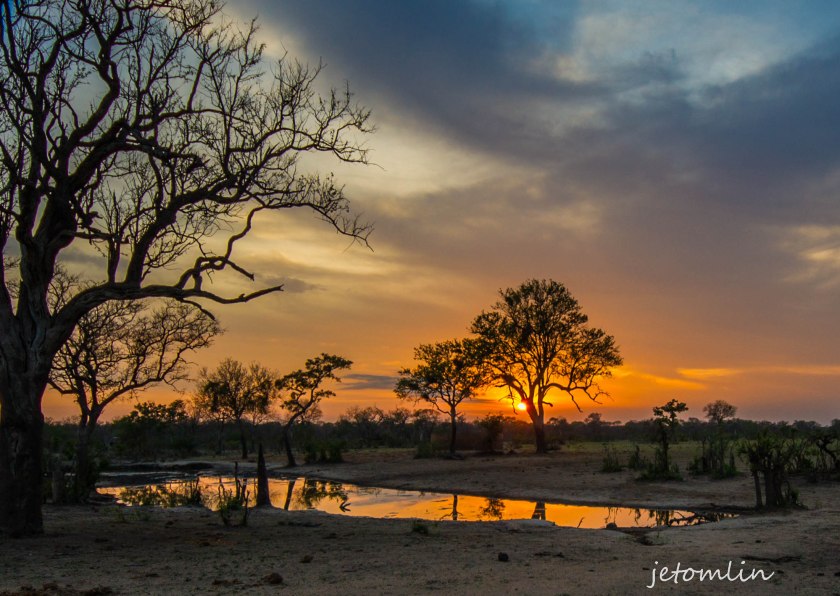
Words can’t do this image justice…well, maybe Robert Frost could, but I digress…was this exquisite sunrise a sign of good things on the horizon?  JET said that now that we had ticked off so many things on the viewing list, she would like to see some lionesses and cubs.  We made our way to Satara for one last time, where I picked up a couple of cups of coffee to go.  As we were walking by the sighting board, a man swaggered up to the board, obviously just back from his own early morning drive, and with no shortage of flourish, placed a marker indicating lions on a road north of the camp, and smugly walked away.

JET looked at me as though to say maybe we should head north and see if we can locate it.  I said that we should really point ourselves south, that we had a long drive and had to keep south if we wanted to arrive in Skukuza by mid afternoon.  We jumped into the Fortuner, and headed south on the H1-3 toward Skukuza.  Soon, we came to the junction with the unpaved S100.  We had earlier talked about going east on that road to the S41, and taking that south to the H6, then back to the H1-3, for a nice loop.  Do we turn left, or go straight?  My gut was telling me we needed to go straight, continuing on the H1-3.  Good call…this is what greeted us a couple clicks down the road…

dsc00488

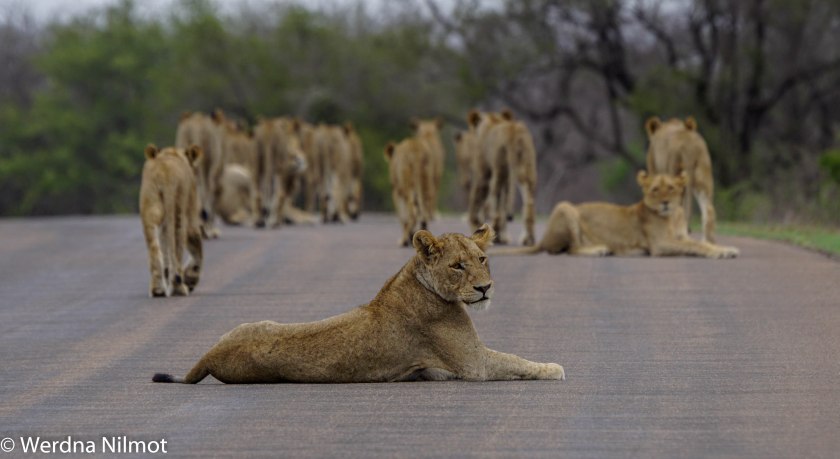
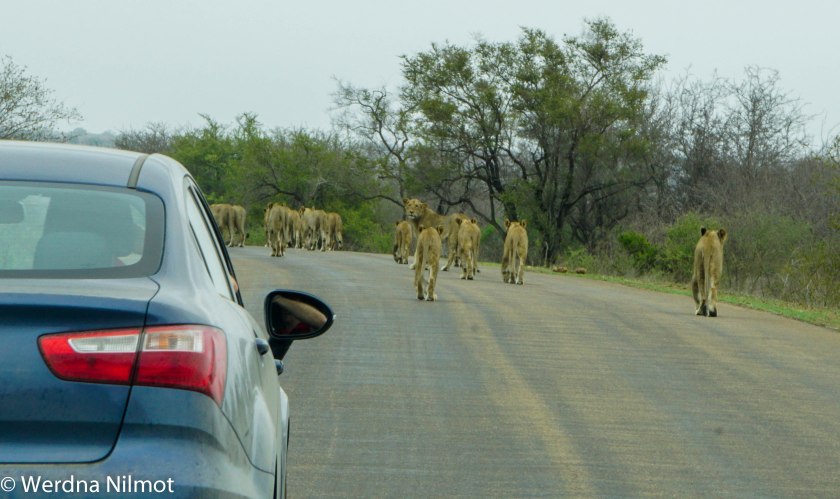
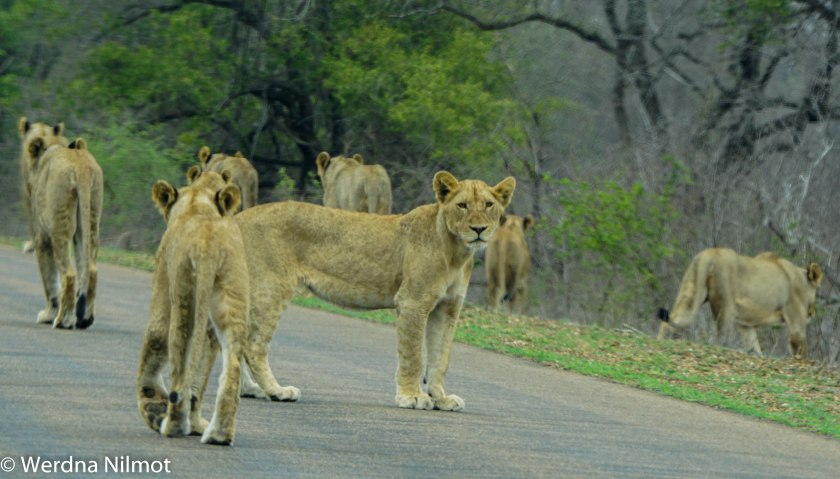
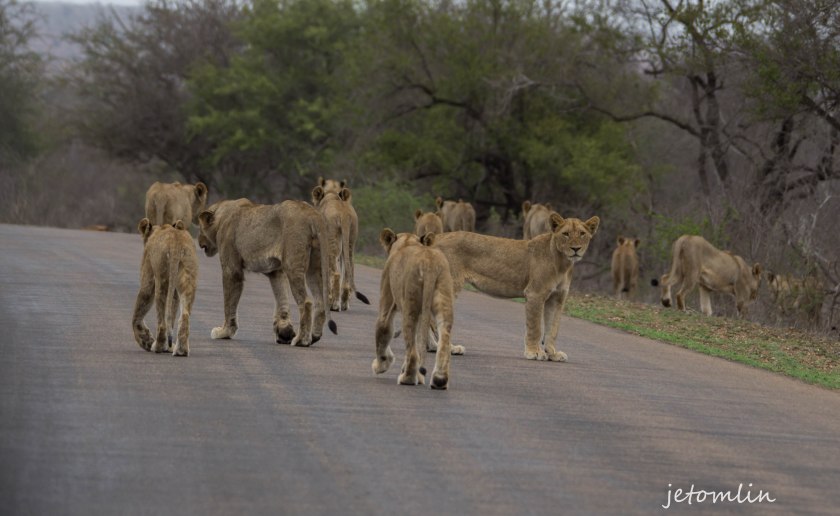
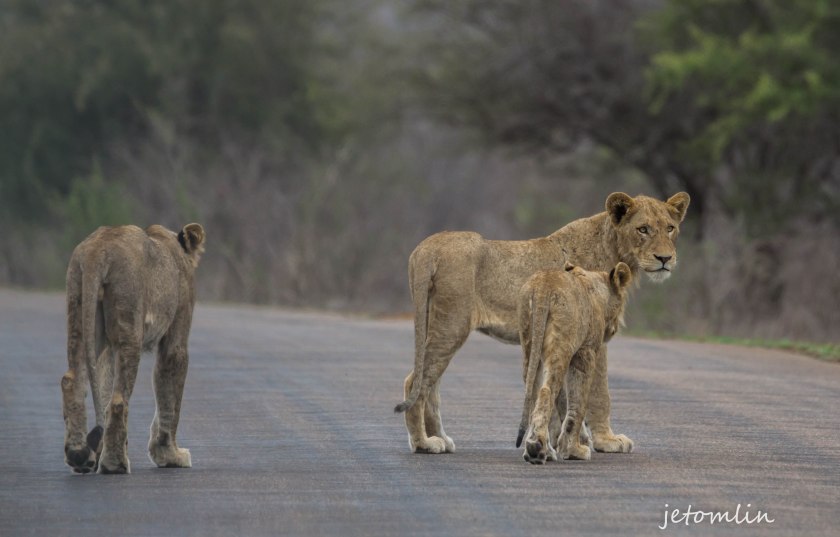
Yes, a pride of 20 something lions and cubs resting on the H1-3 with barely a car in sight.  Two cars, actually, including ours.  The night had been quite cool, and they were probably on the road for warmth before the sun rose.  We enjoyed them for 10 minutes before they headed off into the bush on the right.  Only a single other car joined us, from the south…

dsc00491

dsc00497

We felt fully blessed and in awe that we were witnessing such a sight…

_dsc3111

_dsc3118

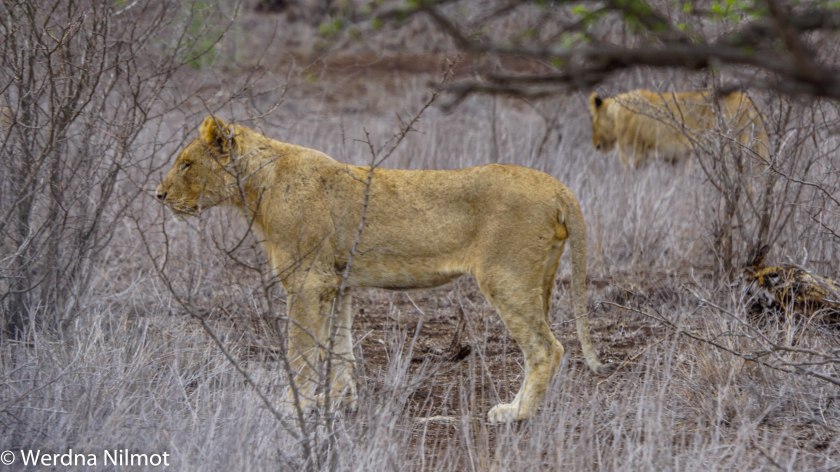
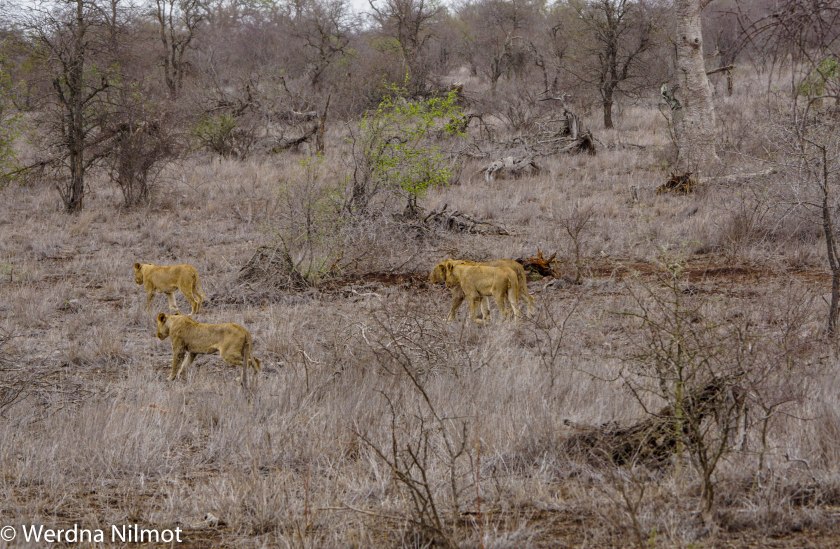
After 10 minutes or so, they all made their way into the bush to our right…

dsc00514

dsc00520

_dsc3157

_dsc3166

After they disappeared, more cars started showing up, totally unaware of what had just happened.  We drove ahead in silence, because we really could not articulate the feelings we had.  Our adrenaline was sky high.  We actually pulled over to the side of the road for about 10 minutes, to process what we had just seen.  This wasn’t supposed to happen to ordinary folks.  This was National Geographic worthy…

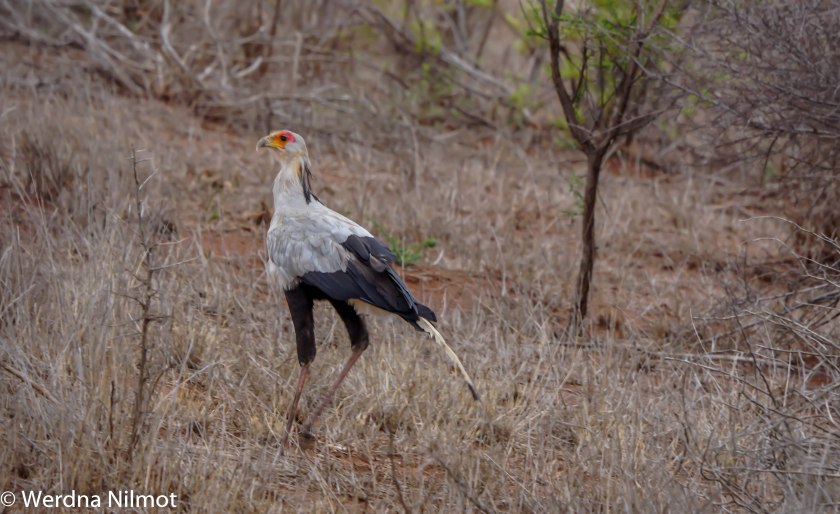
After regaining some equilibrium, we proceeded south once again.  And there it was, another sighting we were hoping for.  A secretary bird.  We saw two of them last November 2015, for a brief second, before they hurriedly took off.  We did not get any photos then.  We did this time…

dsc00531

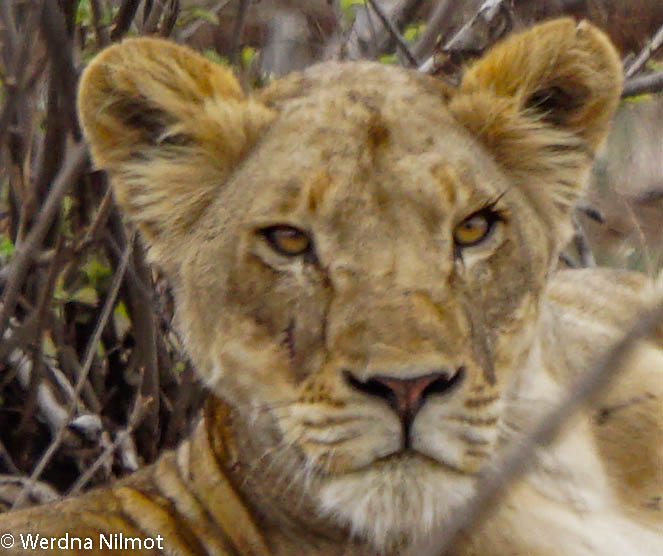
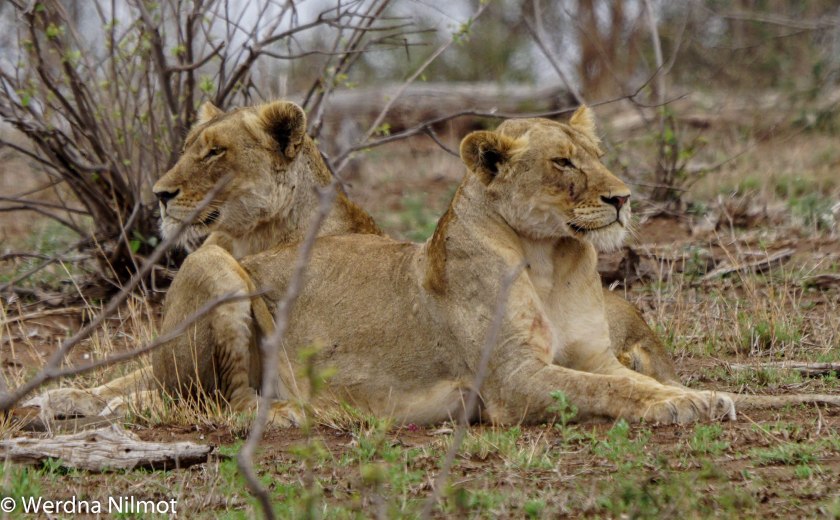
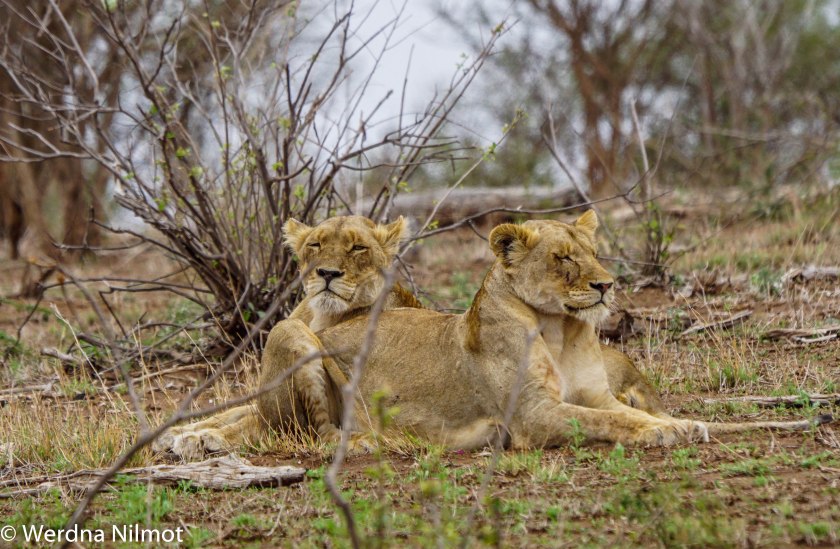
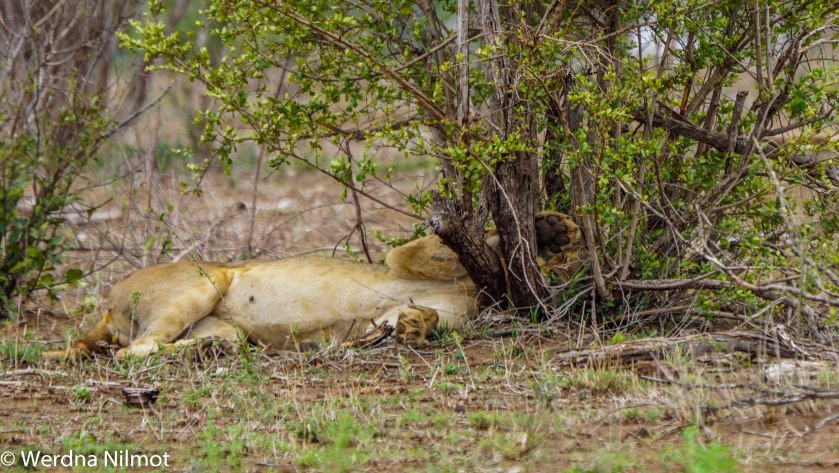
We stopped at Tshokwane for a break, and I marked the lion sighting on the board.  As we were about to leave, JET noticed a guide in a close by vehicle talking to another driver.  She could tell the guide was giving the driver intel, and gave a three fingers sign.  That surely meant “3 of something”.  So, we followed the car as they headed north and turned east onto the S35 toward the Orpen Dam.  About 3 clicks from the tar road, we saw what the intel was about.  3 lionesses resting in plain sight, about 30 meters from the road.  Again, only us and another vehicle, which only stayed for a few minutes.  We spent 45 minutes with them, watching as cars came and went, never more than 2 others…

dsc00569

dsc00577

dsc00584

dsc00560

By this time, we both were mentally fatigued.  Sensory overload.  We stopped a couple vehicles on our way south and passed on the intel regarding the Orpen lionesses.  We arrived at Skukuza mid afternoon, and checked into unit #209 once again.  We unpacked the Fortuner, and I drove it over to the car wash by reception to have the nice young fellow wash off a week’s worth of the Kruger and make it pretty again.  We repacked most of our luggage for the journey home tomorrow.  We then plotted our final half day of game drives for tomorrow morning, before catching our flight to JNB.

We had a celebratory dinner at the Cattle Baron, tipping our glasses to the Kruger, in thanks for a great week (s0 far)…

dsc03102

Day 9 – 26 November 2016

Rain.  That is what greeted us as we awoke.  The Kruger is in dire need of rain.  There has been a severe drought for many months, so the rain was a welcome sight.  It also made the thought of our journey ending easier to bear.  We headed out from our cabin at 410AM, and were second in line at the gate.  We decided to stick to tar roads with the newly washed vehicle.  We had roughly 4 hours to drive, which would allow us 90 minutes to shower and finish packing before checkout at 10AM.

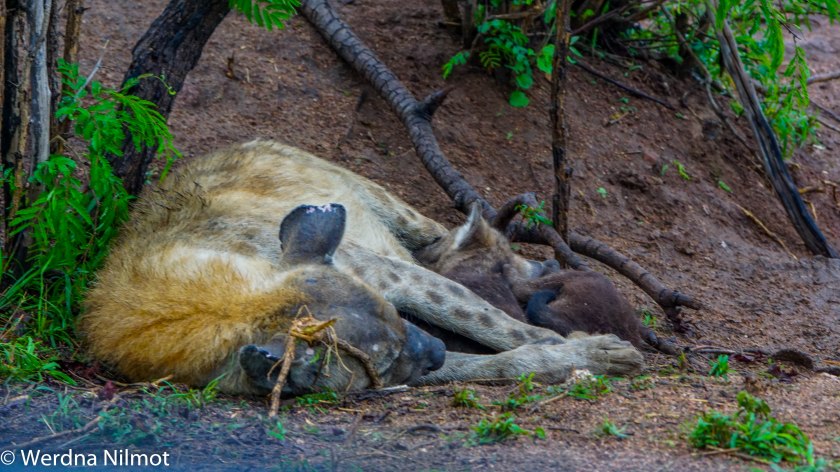
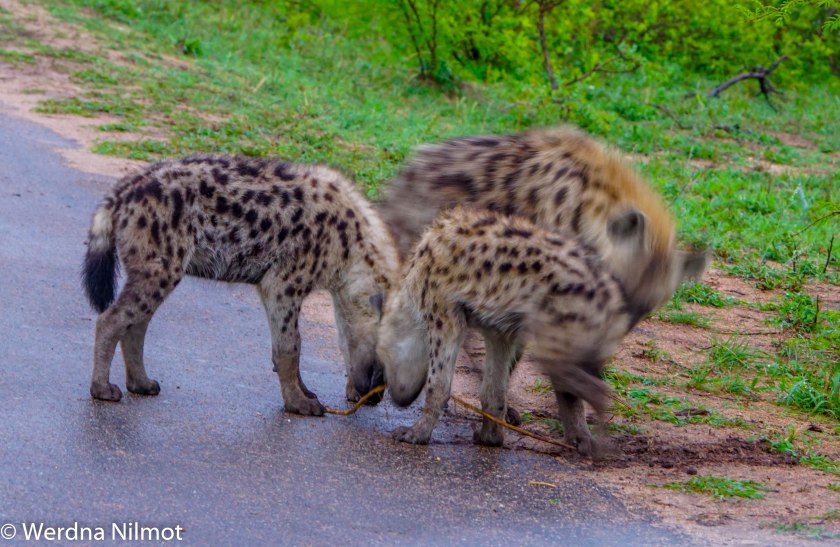
After an hour or so, we came upon a mother hyena sleeping by the side of the road with cubs tucked close to her body.  Juveniles were playing on the road…

dsc00632

dsc00622

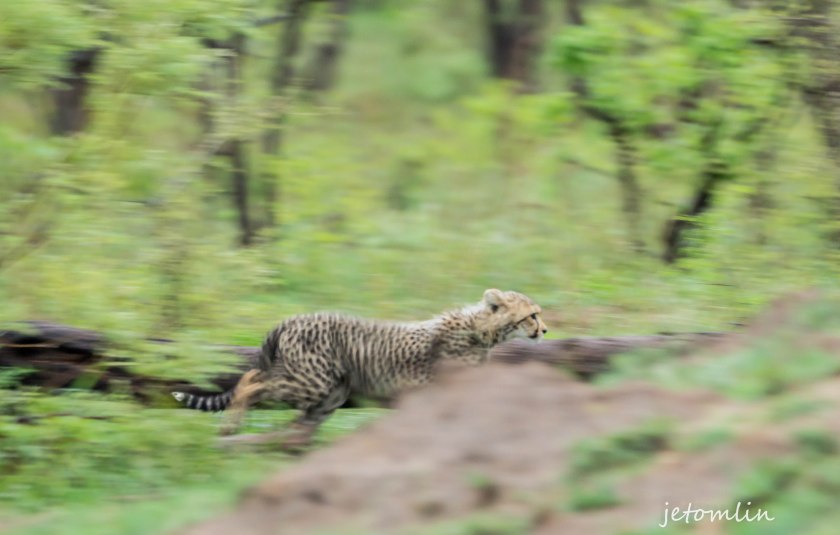
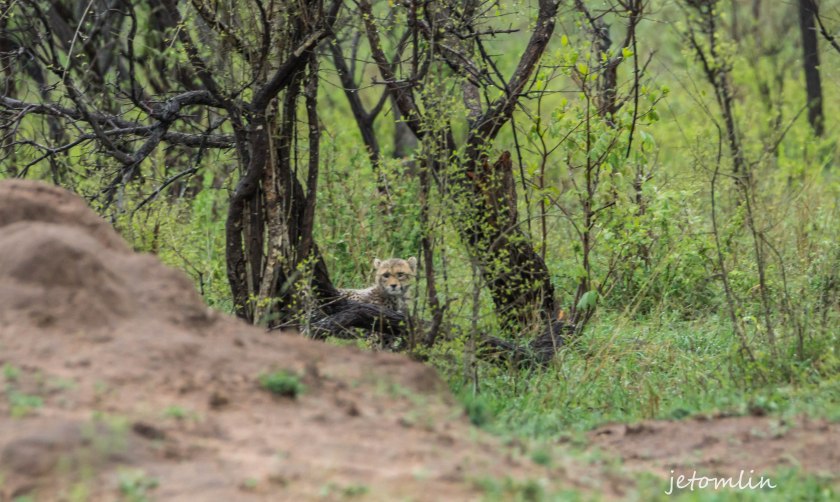
We turned around, intending to head back closer to Skukuza and take a different road for an hour.  After 10 minutes or so, we came upon a few cars stopped in the rain.  A cheetah mother and cub in the bush on our right.  I made the mistake of slowly pulling forward while we looked.  Of course, they emerged from the bush and crossed the road…behind us.  Even so, we got some nice shots.  Lesson learned…going forward, if we ever are in that situation, I will back up and let it play out in front of us…

_dsc3419

_dsc3423

After the third cheetah sighting of our visit, we spent another hour or so slowly driving, always watching the clock.  We saw more animals, dutifully marking them down.  Pretty soon, it was time to take the turn that would point us to the SZK airport and home…

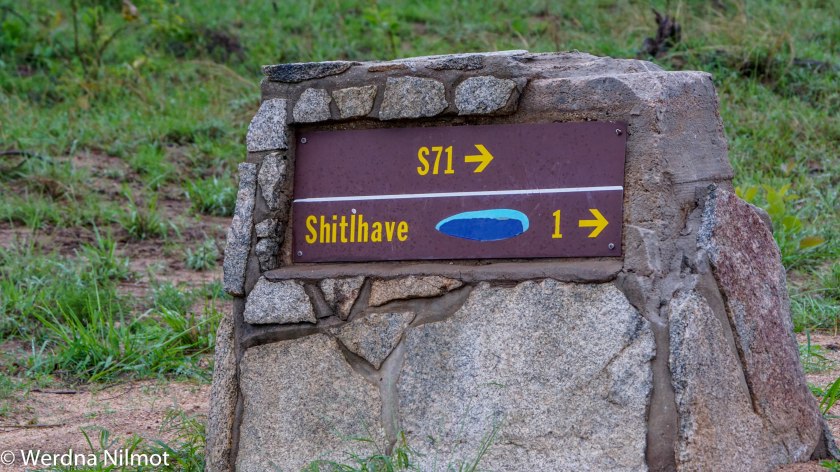
There is a waterhole near Pretoriuskop named “Shitlhave”.  To us, it looked like “Shit I have”.  Much of US culture is centered upon conspicuous consumption and accumulating “things”.  Seeing the sign for “Shitlhave” reminded us that the “shit we have” is more about memories than things, and we are OK with that.

dsc00637

Thank you to the SanParks organization for maintaining such a stellar game preserve.  Thanks to the friendly people of South Africa for their warm hospitality, especially the teams at Biyamiti and Talamati.  And thank you to the animals of the Kruger for allowing us into your home.

A note on rhinos:

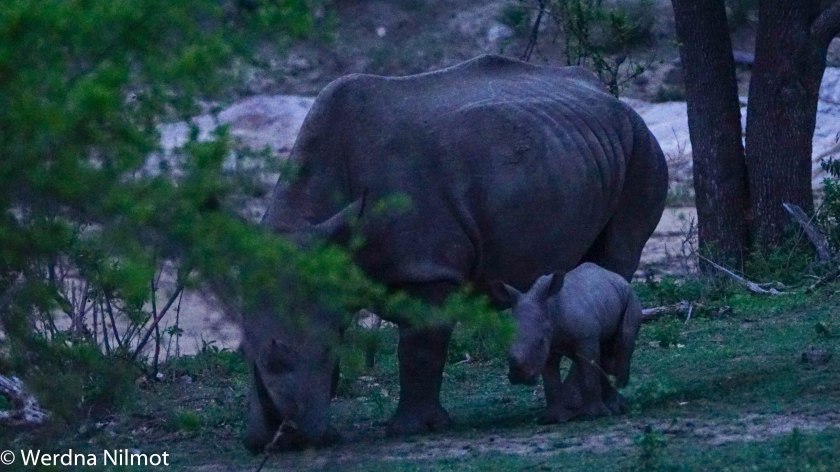
Current estimates suggest that 25,000 rhinos are left on the entire African continent, with the largest concentration being in the Kruger National Park.  Poaching is a huge problem, and the worst of it targets the Kruger.  We were blessed with seeing 51 different white rhinos during our 9 day visit.  I have intentionally avoided mentioning them in this trip report.  There are many evil people out there looking for all means available to locate and poach these beautiful animals.  We should all do everything we can to protect them…

dsc00841

The End

Tall Guy & JET 2016

Photo Details:

Sony Alpha A77 (2 bodies), Sony A77 mkII, Sony A550, Sony RX-100

Sony 70-400mm SSM GII (2 copies)

Sony 500mm f8 AF mirror lens

Sigma 8-16mm super wide angle

no polarizing filters used

all photos shot in RAW format except for the A77 mkII body, which was shot in jpeg extra fine.  Post-processing in Lightroom 4.4